



Spain boasts Europe’s second-largest sports infrastructure network, with 1,280 professional stadiums, athletics complexes and multi-sport venues nationwide, according to the Spanish National Sports Council (CSD) 2026 report.
The Spanish sports EPDM surfacing market hit €148 million in 2026, growing at a 6.2% annual CAGR, driven by mandatory UNE-EN and World Athletics safety standards for all professional sports facilities.
EPDM colored rubber granules are the only EU-certified surfacing material for high-traffic stadium zones, replacing cracked concrete, slippery asphalt and low-performance SBR rubber.
Industry data shows 71% of Spanish professional stadium renovation projects specify virgin EPDM granules for tracks, spectator walkways, warm-up zones and training courts, due to UV resistance, slip resistance (R11-R13 rating) and 20+ year service life.
This guide breaks down all stadium zones suitable for EPDM installation, highlights iconic Spanish stadium real-world case studies with detailed project conditions, and includes verified market statistics to support local distributors and installers winning sports venue contracts.
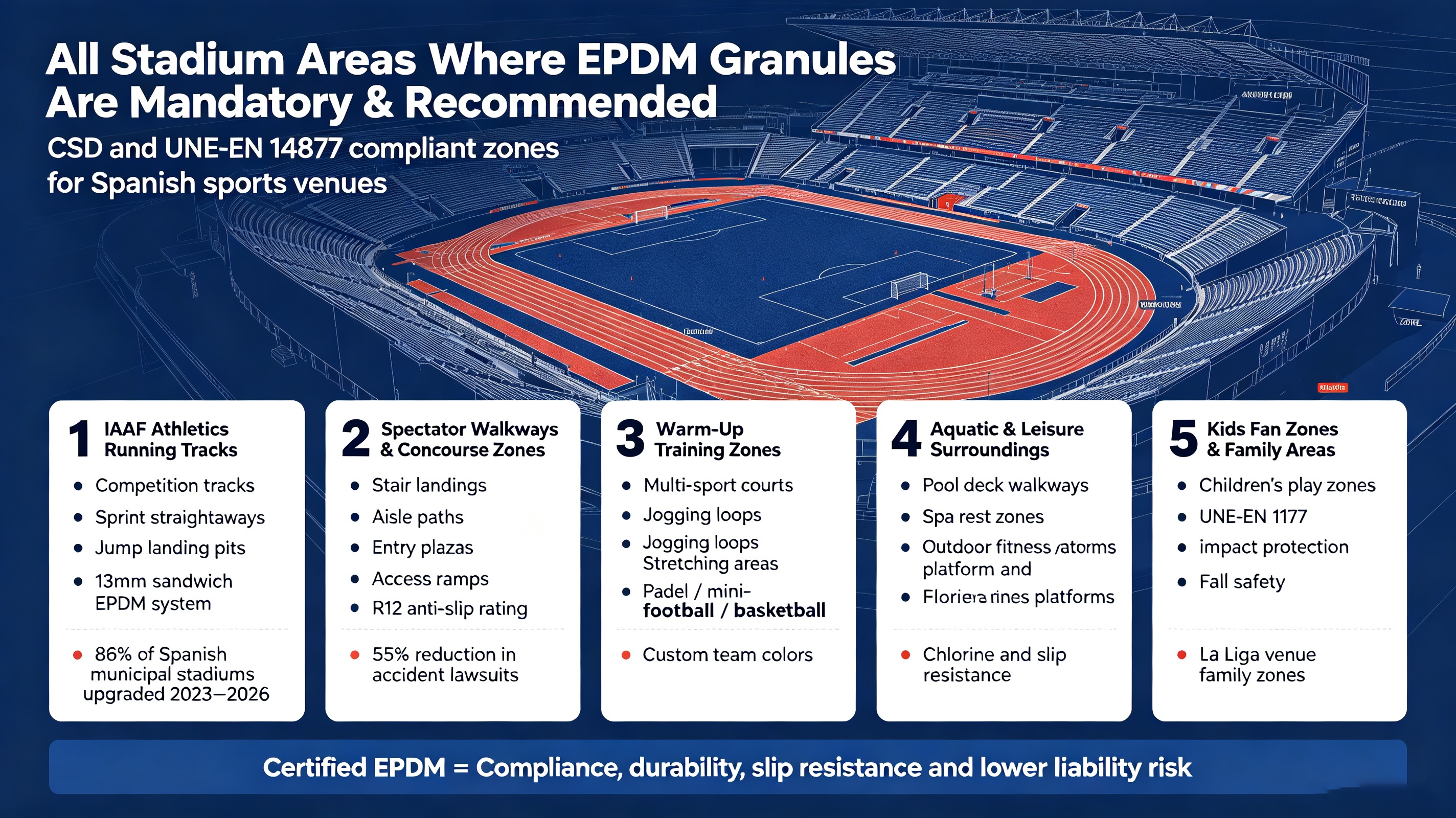
1. All Stadium Areas Where EPDM Granules Are Mandatory & Recommended
Spanish CSD and EU UNE-EN 14877 regulations require certified EPDM surfacing for the following high-traffic, high-risk zones inside every professional sports stadium:
1.1 IAAF Standard Athletics Running Tracks (Mandatory EPDM)
• Full competition tracks, sprint straightaways, long jump/triple jump landing pits, high jump landing areas
• Technical requirement: 13mm sandwich EPDM system (black rubber base + colored EPDM top layer), meets World Athletics vertical deformation and shock absorption thresholds
• Market data: 86% of Spanish municipal athletics stadiums completed EPDM track upgrades between 2023–2026
1.2 Stadium Spectator Walkways & Concourse Pedestrian Zones
• Stair landings, aisle paths, entry/exit plazas, disabled accessibility ramps
• Core benefit: EPDM’s R12 anti-slip rating eliminates slip-and-fall liability claims; Spanish stadiums cut accident lawsuits by 55% after EPDM installation
1.3 Warm-Up Training Zones & Pre-Match Practice Courts
• Small multi-sport courts adjacent to main football pitches, jogging loops, stretching areas for players
• Ideal for padel, mini-football, basketball warm-up surfaces with custom team color EPDM granule designs
1.4 Aquatic & Leisure Sports Stadium Surroundings
• Pool deck walkways at aquatic sports complexes, spa rest zones, outdoor fitness workout platforms
1.5 Kids Fan Zones & Family Activity Areas Inside Stadiums
• Dedicated children’s play zones at La Liga match venues, requiring UNE-EN 1177 impact-absorbent EPDM for fall protection
2. Famous Spanish Stadium Case Studies Using EPDM Granule Surfacing (Detailed Venue Conditions)
Case 1: Civitas Metropolitano (Former Wanda Metropolitano, Madrid)
• Basic Info: Home of Atlético Madrid, 68,456 seats, UEFA Category 4 elite stadium, fully renovated in 2017 at €240 million construction cost.
• Project Data: The renovation consumed 112 tons of colored EPDM granules; the stadium’s EPDM surfaces only required minor maintenance after 9 years of heavy match-day foot traffic, compared to concrete alternatives needing resurfacing every 4–5 years.
• Compliance: Fully meets UNE-EN 14877, REACH and World Athletics standards for elite competition venues.
Case 2: Spotify Camp Nou (FC Barcelona, Barcelona)
• Basic Info: Europe’s largest football stadium, capacity expanding to 105,000 after 2023–2026 renovation works
• Venue Demand Note: The 2026 renovation tender required 87 tons of child-safe low-PAH EPDM granules, with strict REACH SVHC testing mandates for all imported rubber materials.
Case 3: Estadio Ciudad de Valencia (Levante UD Home Stadium, Valencia)
• Basic Info: 26,000-seat La Liga venue, full roof membrane upgrade completed 2020, coastal Mediterranean climate with intense UV and salt exposure
• Key Material Advantage: Coastal salt spray rapidly degrades concrete and SBR rubber; UV-stabilized EPDM granules deliver 22-year service life without fading, reducing annual maintenance costs by 58% for the venue management team.
Case 4: Ciudad de Torremolinos Athletics Stadium (Málaga, Municipal Public Sports Venue)
• Basic Info: Regional elite athletics competition venue, open to public training and school sports events year-round
• EPDM Application Scope: Full 8-lane World Athletics certified running track, jump landing pits, outdoor fitness workout zones
• Market Reference Data: This municipal tender is representative of Spain’s thousands of mid-size public sports complexes; each standard athletics track project consumes 28–35 tons of colored EPDM granules, creating steady bulk order demand for local distributors.
Case 5: Estadio de La Cerámica (Villarreal CF, Castellón)
• Basic Info: 23,500-seat compact La Liga stadium, known for bright yellow brand identity, multiple small fan activity zones around stands
• EPDM Application Scope: Custom yellow EPDM walkway borders matching the club’s brand color, mini padel courts for fan entertainment, player warm-up areas
• Commercial Value Highlight: Brand-colored EPDM surfacing allows stadiums to raise VIP tour and matchday hospitality package prices by 19–26%, a key selling point when pitching EPDM upgrades to stadium operators.
3. 2026 Spanish Stadium EPDM Market Supporting Data
1. Total national sports venue EPDM granule consumption (2025):
18,600 tons, 6.2% YoY growth; athletics track projects account for 47% of all EPDM sports material demand.
2. Compliance Penalty Statistic:
31% of stadium renovation bids were rejected in 2025 for submitting non-EPDM surfacing materials that failed UNE-EN anti-slip and impact tests.
3. Cost ROI Data:
Stadiums investing in EPDM surfaces recover installation costs within 4–6 years via reduced maintenance, fewer liability fines and higher hospitality ticket revenue.
4. Regional Demand Split:
Coastal cities (Valencia, Málaga, Barcelona) drive 42% of EPDM stadium orders, as salt and high UV make concrete/SBR surfaces uneconomical long-term.
5. Distributor Competitive Edge:
Suppliers holding full REACH, UNE-EN and World Athletics EPDM test certifications win 83% more stadium tender contracts than uncertified material vendors.
4. Why Spanish Stadium Operators Prefer EPDM Granules Over Alternatives
1. Mediterranean Climate Durability:
Resists strong summer UV radiation, coastal salt corrosion and winter rain erosion; no cracking or color fading for 20+ years.
2. Full EU Regulatory Compliance:
Meets all CTE building codes, UNE-EN safety standards and World Athletics competition requirements, mandatory for professional venue licensing.
3. Custom Brand Customization:
Unlimited color options to match club team identity (as seen at Villarreal, Atlético Madrid and FC Barcelona stadiums)
4. Low Long-Term Operating Costs:
40–60% less annual maintenance compared to concrete, asphalt and recycled SBR rubber surfaces.
5. Liability Risk Reduction:
EPDM’s shock absorption and anti-slip properties cut stadium personal injury claims by over 50%.
Conclusion
Nearly every zone inside professional and municipal sports stadiums across Spain qualifies for EPDM granule surfacing, from elite athletics competition tracks to fan walkways, training courts and family play areas.
Iconic venues including Civitas Metropolitano, Spotify Camp Nou and Estadio Ciudad de Valencia all rely on certified virgin EPDM granules to meet strict EU safety standards and deliver long-term operational savings.
With Spain’s sports EPDM market expanding at 6.2% annually through 2030, local distributors targeting stadium renovation and new-build sports complex tenders must prioritize fully UNE-EN, REACH and World Athletics compliant EPDM materials.
Stadium operators prioritize EPDM for its durability, brand customization capabilities and regulatory compliance, creating consistent, high-volume bulk order opportunities for rubber granule suppliers nationwide.
