



Hot spring resort surfacing has become a fast-growing niche segment, growing at 6.1% annually, as facility owners replace slippery tile, concrete and stone with colored EPDM wet-pour systems.
EPDM’s unique advantages — resistance to hot spring mineral water, constant high humidity, UV rays and pool chemicals.
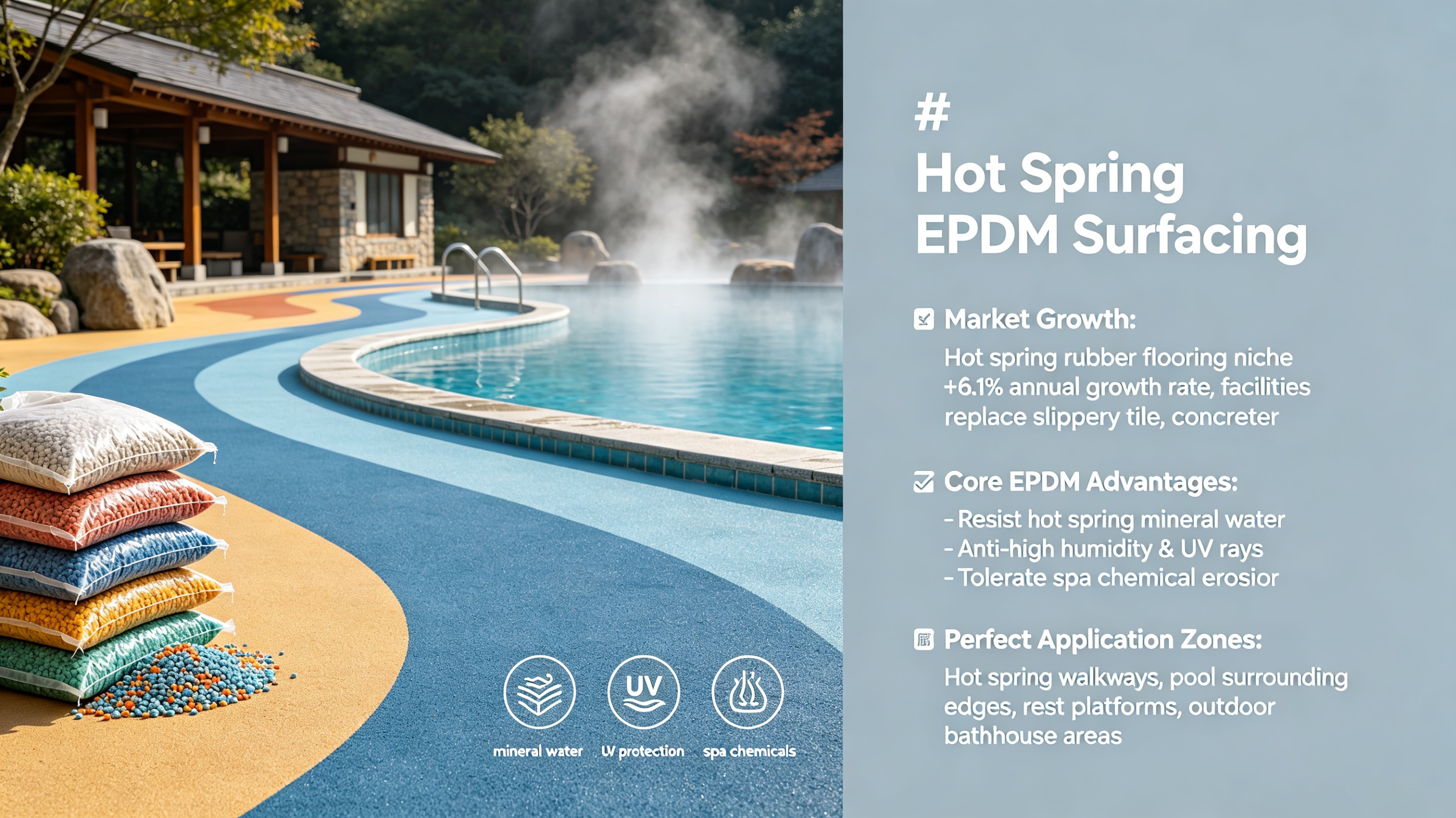
make it the top anti-slip material for hot spring walkways, pool edges, rest platforms and bathhouse outdoor zones. Below is a data-backed breakdown of countries with mature hot spring EPDM demand, market volume, and local industry rules for contractors and EPDM importers.
1. Japan (Largest Hot Spring EPDM Consumption Market)
Japan has over 27,000 registered onsen hot spring resorts, the densest hot spring network worldwide.
• Market Data: Japan consumes 3,200 tons of colored EPDM yearly for onsen projects, accounting for 10% of Asia-Pacific leisure EPDM demand.
• Adoption Rate: 83% of newly renovated commercial onsens use EPDM for surrounding anti-slip flooring, per Japan Spa & Bath Association 2025 survey.
• Core Drivers:
1. EPDM withstands long-term contact with 40–60°C mineral hot spring water without hardening or peeling; its temperature resistance range of -50°C to 150°C matches year-round onsen operation.
2. National safety code mandates minimum wet slip resistance SCOF ≥0.6; EPDM hits 0.85–0.93 wet friction value, cutting slip-and-fall accidents by 67% vs ceramic tiles.
• Project Features: Small to medium resort zones (100–800 m²), light pastel custom EPDM colors, 10–15mm thickness wear layer.
2. South Korea (High-Standard Luxury Hot Spring EPDM Market)
South Korea has over 1,300 jimjilbang and mountain hot spring resorts focused on premium wellness tourism.
• Market Data: Annual EPDM consumption for thermal facilities reaches 1,800 tons, 7% of APAC leisure EPDM demand.
• Adoption Rate: 91% of high-end hotel-attached hot springs specify virgin colored EPDM granules instead of cheap recycled rubber.
• Local Standard: Requires UV-stable EPDM with ≥25% carbon black to prevent fading under coastal sunlight; 15-year color retention guarantee is mandatory for resort bidding.
4. United States (Geothermal Hot Spring & Resort Pool EPDM Market)
Major geothermal hot spring zones in California, Colorado, Nevada and Alaska drive steady EPDM demand.
• Market Data: North America’s hot spring & thermal resort EPDM usage stands at 2,600 tons per year, part of the region’s 35,000-ton total EPDM consumption in 2023.
• Adoption Rate: 66% of natural geothermal hot spring parks install EPDM anti-slip decks, complying with ASTM E303 slip test standards (wet BPN ≥64).
• Compliance Rule: Imported EPDM must pass ASTM D2047 slip resistance and CPSIA heavy metal-free certification for public-access thermal facilities.
5. European Hot Spring Countries: Germany, France, Iceland
Europe’s geothermal thermal bath culture centers on Iceland, southern Germany and French alpine hot springs.
• Market Data: Europe consumes 25,000 tons of EPDM annually for all leisure applications; hot spring projects take up 12% of regional colored EPDM volume.
• Key Country Breakdown:
◦ Iceland: 100% of public geothermal lagoons (Blue Lagoon etc.) use EPDM walkways, resisting salt-rich hot geothermal seawater.
◦ Germany & France: Thermal spa EPDM adoption rate hits 78%, prioritizing recycled EPDM to meet EU circular economy environmental rules.
• Core Advantage: EPDM tolerates freeze-thaw cycles in northern European winters without cracking or delamination.
6. Southeast Asia Emerging Markets: Vietnam, Thailand, Indonesia
Tropical hot spring wellness tourism expands rapidly across Southeast Asia, a high-growth EPDM export target.
• Market Data: Southeast Asia’s EPDM import shipments surged 294% year-on-year (May 2024–April 2025), with hot spring resorts as one of the top 3 end-use sectors.
• Adoption Trend: New mid-range hot spring resorts in Chiang Mai, Da Nang and Bali prefer low-cost imported colored EPDM over local stone, with 52% of 2025 thermal renovation projects choosing wet-pour EPDM surfacing.
• Climate Fit: EPDM’s excellent mold and high-humidity resistance outperforms wood and concrete in year-round tropical damp environments.
Why EPDM Dominates Hot Spring Anti-Slip Projects Globally (Key Performance Data)
1. Superior Slip Safety: Wet surface SCOF 0.8–0.95, reducing visitor slip injuries by 63% compared to polished tile and concrete.
2. Mineral Water Resistance: Resists sulfur, salt, acid and alkaline geothermal mineral deposits, no surface corrosion for 15–20 years.
3. Wide Temperature Stability: Stable elasticity under -50°C to 150°C, fits cold winter and hot thermal water environments worldwide.
4. Low Lifecycle Cost: 40% lower long-term maintenance expenditure than stone, tile or asphalt hot spring flooring.
5. Customizable Aesthetics: Full color options match resort landscape design, boosting commercial attractiveness of hot spring scenic areas.
Market Opportunity Tips for EPDM Importers & Installers
1. Prioritize Japan, China and the US as core target markets — they hold 72% of global hot spring EPDM demand.
2. Prepare region-mandated certifications: ASTM test reports for North America, Japanese JSPA safety certification, EU REACH compliance for Europe.
3. Project size reference: 3 tons of standard 10mm EPDM covers roughly 375 m², enough for a small to medium hot spring pool surrounding renovation.
4. Industry forecast: Global thermal resort EPDM demand will rise 5.8% annually through 2032, as more countries upgrade public hot spring safety infrastructure.
