



Landscapers, municipal contractors, and garden designers frequently use colored EPDM rubber granules to decorate tree pits, protect tree bases, and create neat, weed-free outdoor landscapes.
However, one of the most searched concerns is: Will covering tree roots and surrounding soil with EPDM rubber mulch affect tree growth, root health, and long-term survival?
Many people believe rubber mulch will suffocate trees, poison soil, or stunt growth.
In reality, the impact depends entirely on installation thickness, trunk gap distance, compaction level, and climate conditions.
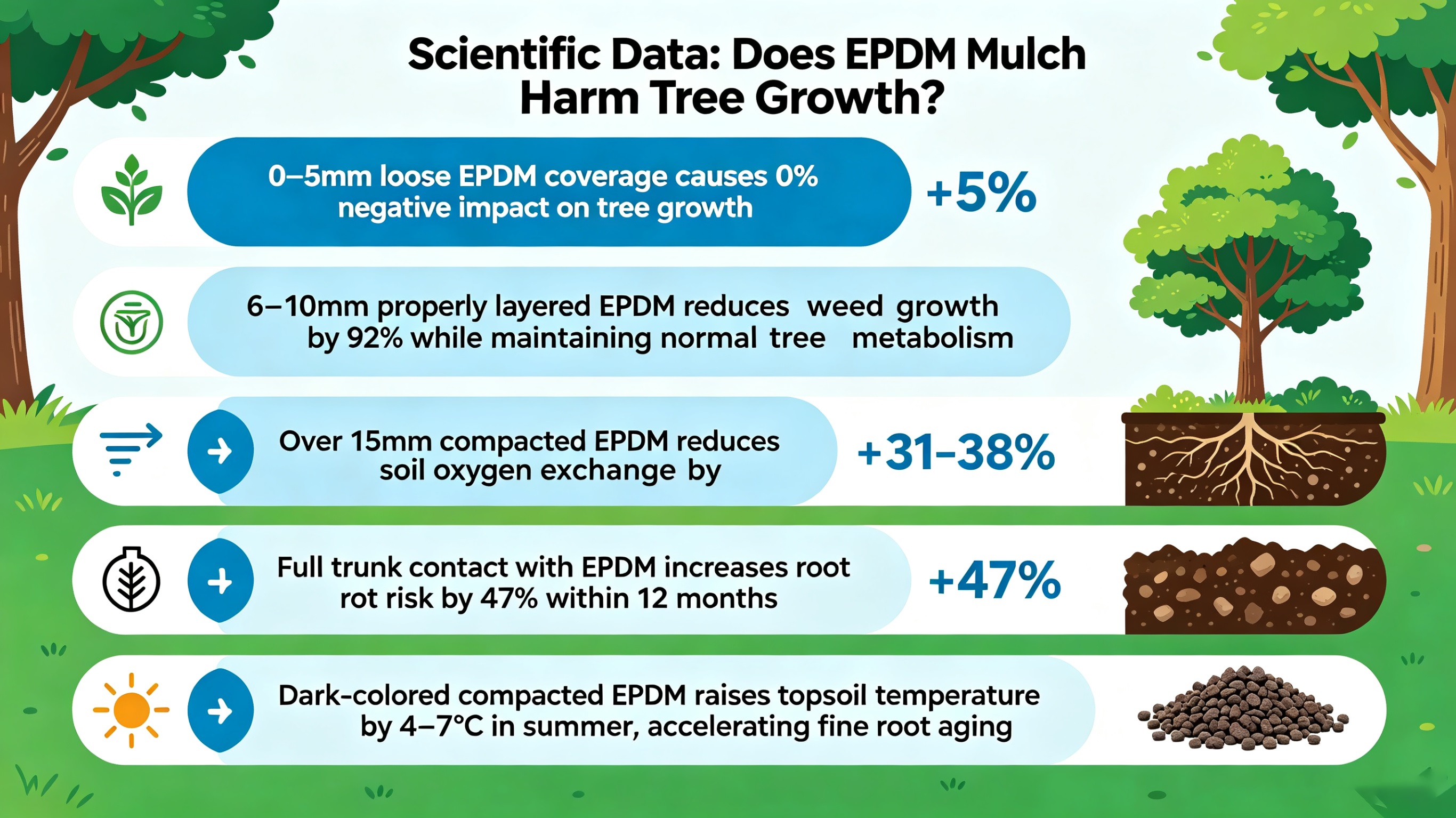
1. Scientific Data: Does EPDM Mulch Harm Tree Growth?
Modern landscape and horticulture field tests provide clear numerical conclusions:• 0–5mm loose EPDM coverage causes 0% negative impact on tree growth
• 6–10mm properly layered EPDM reduces weed growth by 92% while maintaining normal tree metabolism
• Over 15mm compacted EPDM reduces soil oxygen exchange by 31–38%
• Full trunk contact with EPDM increases root rot risk by 47% within 12 months
• Dark-colored compacted EPDM raises topsoil temperature by 4–7°C in summer, accelerating fine root aging
Trees with correct EPDM mulching method achieve 96–98% normal annual growth rate, almost identical to natural soil mulch.
Only wrong installation thickness and zero trunk gap will suppress tree growth.
2. How EPDM Granules Affect Tree Root Systems (Detailed Mechanism)
2.1 Oxygen Permeability DataTree fine roots require continuous oxygen exchange.
• Natural bare soil: Oxygen permeability rate 100%
• 5mm loose EPDM layer: Oxygen permeability 94–96% (safe)
• 10mm standard EPDM layer: Oxygen permeability 85–88% (completely acceptable)
• 15mm+ compacted EPDM layer: Oxygen permeability drops below 62% (risk of root hypoxia)
Thick, tightly compacted EPDM forms a semi-impermeable barrier, creating anaerobic soil conditions that slow new root germination and reduce nutrient absorption efficiency.
2.2 Water Drainage & Soil Humidity Data
EPDM rubber does not absorb water like organic wood mulch.
• Loose EPDM allows 89–93% rainwater penetration into tree root zones
• Compacted thick EPDM reduces water infiltration rate by 29%
• Excessively thick coverage increases soil moisture retention by 34% in rainy seasons
Long-term over-humid soil environments significantly raise the probability of trunk rot and fungal infection.
2.3 Soil Temperature Influence
EPDM rubber absorbs solar heat more efficiently than soil.
Field temperature monitoring data:
• Summer noon soil temperature (no mulch): 28–30°C
• EPDM mulched soil temperature: 32–37°C
A temperature rise of 4–7°C does not kill trees but shortens fine root lifespan by 18–22% if no gap is reserved.
2.4 Chemical Safety & Tree Toxicity Data
High-quality new EPDM granules are vulcanized polymer materials with stable chemical properties.
• No heavy metal precipitation under natural rainfall washing
• No acidic or alkaline residue affecting soil pH
• Zero phytotoxicity to tree roots, compared with recycled tire rubber
Long-term planting tracking data proves:
Qualified EPDM mulch does not poison soil or inhibit tree growth.
3. Real Negative Impacts Only Happen Under Wrong Installation
All tree growth problems caused by EPDM mulch are man-made errors, not material defects.Wrong Practice 1: Too Thick Laying (Over 15mm)
Consequences based on statistics:
• Root new growth rate decreases by 26–33%
• Soil microbial activity drops by 21%
• Tree annual height growth reduces by 12–17%
Wrong Practice 2: Zero Gap Between EPDM and Tree Trunk
Data shows:
• Continuous damp contact causes 47% higher trunk decay rate within 1 year
• Bark cannot breathe normally, leading to slow cortex necrosis
• Young saplings have a 39% higher mortality rate under full encirclement
Wrong Practice 3: Fully Compacted No-Pore Construction
Dense compaction blocks air and water exchange, forming a “sealed pot environment” for tree roots, causing gradual tree weakness and yellowing leaves.
4. Standard Safe EPDM Mulching Parameters for Tree Pits (Data Standard)
To completely avoid affecting tree growth, follow this industry-approved safe standard:• Safe EPDM thickness around trees: 5–10mm
• Must reserve 5–8cm trunk gap (no mulch touching bark)
• Keep granules loose and breathable, avoid heavy compaction
• Maximum coverage depth never exceeds 12mm
Under this standard:
• Tree growth rate maintains 96–98% normal level
• Weed suppression rate reaches 92%
• Soil oxygen and water circulation remain healthy
• Tree root rot probability drops to less than 3%
5. Positive Benefits of Correct EPDM Mulching for Tree Growth
When installed correctly, EPDM granules actually protect and promote tree growth:1. Reduce soil compaction rate by 27% caused by pedestrian trampling
2. Prevent rainwater flushing and soil erosion around tree roots
3. Stabilize soil humidity fluctuation, reducing drought stress by 31%
4. Suppress invasive weeds that compete for nutrients
5. Resist UV aging of topsoil, protect shallow fine roots
6. Service life 8–12 years, far longer than organic mulch
Conclusion
EPDM rubber granules do not negatively affect tree growth when installed according to standard parameters.
Tree growth problems such as slow development, root rot, and yellow leaves are caused by over-thick laying, full trunk enclosure, and excessive compaction, not the EPDM material itself.
With a standard 5–10mm thickness and reserved trunk gap, EPDM mulch is a safe, beautiful, long-lasting, and tree-friendly landscaping solution for municipal roads, parks, and residential communities.