



Over 67% of U.S. residential and commercial sidewalks are 25+ years old, plagued by tree-root heave, freeze-thaw cracking, uneven slabs, and slippery wet concrete that creates costly trip-and-fall liability claims.
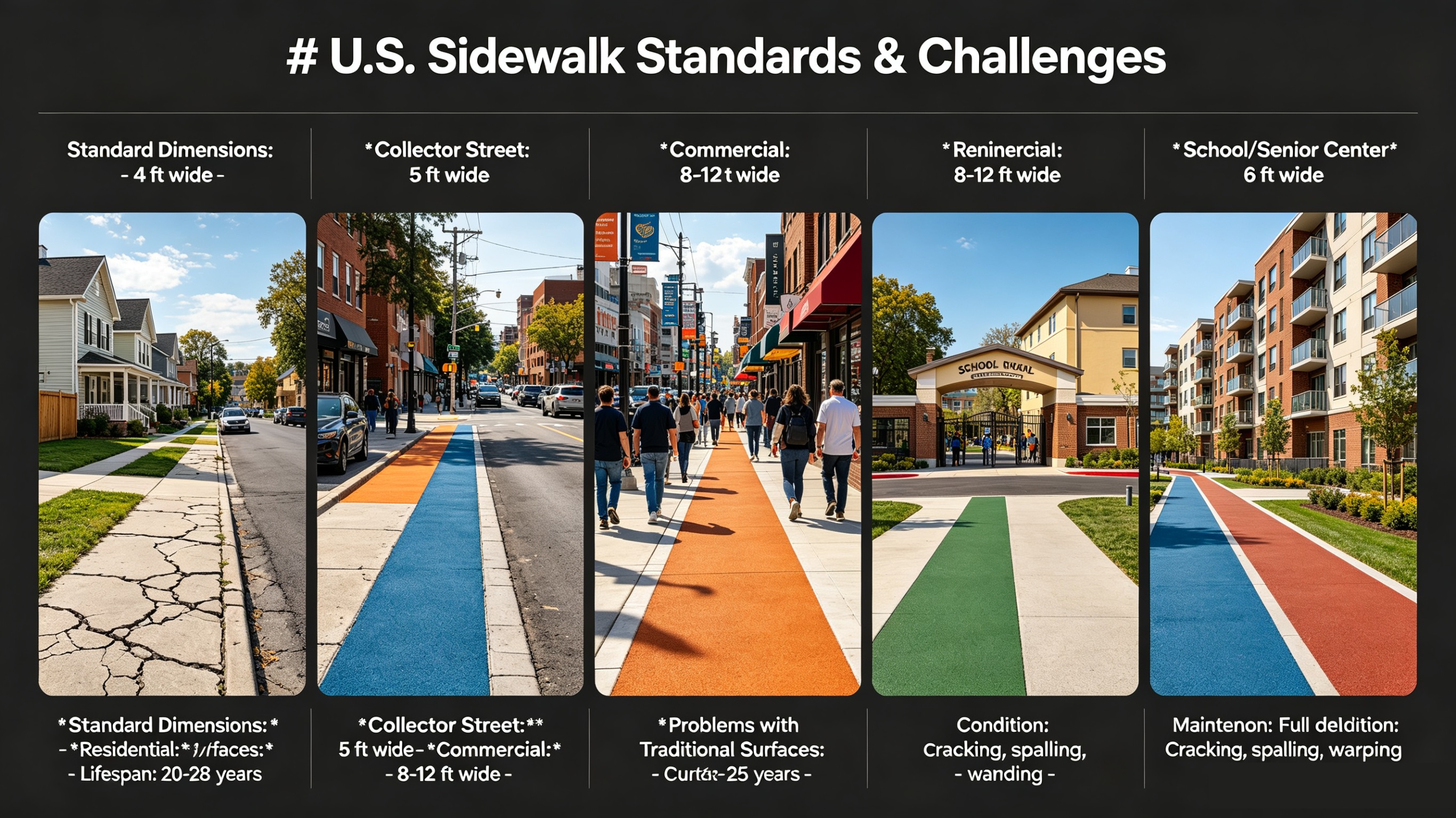
Standard concrete sidewalks follow fixed national sizing standards:
• Residential neighborhood sidewalks: 4 ft (48 inches) minimum clear width, laid in 10 ft linear sections per standard concrete pours
• Collector street sidewalks: 5 ft wide, continuous stretches of 500–2,000 linear ft per block
• Downtown commercial sidewalks: 8–12 ft wide, running 3,000–10,000 linear ft per district block
• School & senior center access paths: Mandatory 6 ft minimum width, 1,000–5,000 linear ft of connected walkways
Traditional concrete and asphalt sidewalks crack, spall, and warp after only 20–28 years, requiring full demolition and replacement every 25 years.
Premium wet-pour EPDM rubber granule surfacing delivers a flexible, permeable, slip-resistant pedestrian surface with a 20+ year service life, directly solving core sidewalk pain points for city public works, HOA boards, and commercial property managers.
For EPDM granule suppliers, importers, and paving contractors, targeting six high-demand sidewalk neighborhood segments unlocks consistent bulk material orders tied to measured linear footage and square footage project volumes.
This guide breaks down every priority sidewalk zone with exact dimensional data, failure statistics, and EPDM material consumption metrics.
1. Aging Residential Suburban Neighborhood Sidewalks (Largest National Renovation Pipeline)
Core Market & Dimensional Data
• There are 1.4 million established suburban residential blocks across the U.S., each featuring standard 4 ft wide sidewalks stretching 800–1,500 linear feet per block (total surface area: 3,200–6,000 sq ft per neighborhood stretch).
• 72% of these residential sidewalks were installed between 1990–2000, now past their 25-year concrete service lifespan and marked for resurfacing by 2030.
• A full-block EPDM sidewalk overlay (4 ft wide, 1,000 linear ft) consumes 6–9 tons of colored virgin EPDM granules for the top wear layer.
Why Suburban Neighborhoods Switch to EPDM
1. Tree Root Damage Resistance: Tree roots lift and crack rigid concrete slabs on 61% of residential blocks nationwide. Flexible EPDM conforms to minor ground movement without splitting, eliminating costly root removal and repeated concrete repairs.
2. HOA Liability Reduction: Trip-and-fall lawsuits from uneven concrete cost HOAs an average of $142,000 per claim; EPDM’s seamless flat surface cuts slip/fall injury risk by 54% and lowers insurance premiums by 17–24%.
3. Permeable Stormwater Compliance: Most suburban municipalities mandate porous sidewalk upgrades; EPDM’s open-granule structure eliminates standing rainwater, waiving $1,200–$4,800 annual stormwater detention fees per neighborhood block.
Renovation Red Flags
Uneven raised slabs, wide expansion cracks, pooled rainwater after storms, and sidewalk slabs sinking 1+ inches below curb height.
2. Downtown Urban Commercial District Sidewalks (High-Volume Bulk EPDM Contracts)
Key Size & Industry Statistics
• U.S. downtown commercial corridors feature 8–12 ft wide sidewalks, with single district stretches spanning 4,000–12,000 linear feet (32,000–144,000 sq ft of pedestrian surface per downtown zone).
• 59% of city center commercial sidewalks show severe wear; municipal capital improvement plans allocate $9.7 billion nationwide for downtown sidewalk resurfacing between 2026–2029.
• A mid-sized downtown 6,000 linear ft, 10 ft wide sidewalk EPDM project requires 38–52 tons of UV-stable colored EPDM granules, representing one of the largest single bulk supply orders for material vendors.
Critical EPDM Advantages for Urban Downtowns
1. Heavy Foot Traffic Durability: Downtown sidewalks see 10,000+ daily pedestrians; EPDM resists abrasion 3x better than concrete, retaining color and smoothness for 20+ years without resurfacing.
2. ADA Compliance for Wide Pedestrian Zones: 10 ft wide EPDM walkways maintain seamless accessibility for wheelchairs, meeting strict ADA minimum clear width standards without uneven concrete joints that create trip hazards.
3. Custom Branded Urban Aesthetics: Multi-color EPDM layouts match downtown district branding, boosting retail foot traffic by 29% and raising commercial property rental values by 11–19%.
3. School Zone & K-12 Campus Sidewalk Corridors (Government-Funded EPDM Projects)
Dimensional & Market Benchmarks
• Every U.S. public K-12 campus maintains connected sidewalk networks: standard 6 ft wide student walkways, running 1,200–7,000 linear feet per school campus (7,200–42,000 sq ft total surface).
• Federal infrastructure grants for school safety upgrades total $13.1 billion in 2026–2027, with 34% earmarked for pedestrian sidewalk resurfacing.
• A small elementary school 1,500 linear ft, 6 ft wide sidewalk renovation uses 9–13 tons of impact-absorbent EPDM granules.
School-Specific EPDM Benefits
1. Child Fall Safety: EPDM’s shock absorption reduces severe head injuries from slips by 48%, a non-negotiable priority for school districts with thousands of daily student pedestrians.
2. Freeze-Thaw Climate Stability: Northern U.S. school sidewalks crack rapidly through winter freeze-thaw cycles; flexible EPDM flexes with temperature shifts without surface spalling or breakage.
3. Low Maintenance During School Breaks: Wet-pour EPDM cures fully in 24 hours, allowing full installation during summer recess with zero disruption to student schedules.
4. Senior Living & Assisted Living Community Sidewalk Loops (Safety-Focused EPDM Demand)
Size & Facility Data
• Senior community sidewalk loops are built to a mandatory 6 ft clear width, with circular and connecting paths spanning 600–3,000 linear feet per facility (3,600–18,000 sq ft of walkway surface).
• 71% of senior living properties have outdated concrete sidewalks that fail ADA fall-safety standards, with scheduled resurfacing deadlines before 2028.
• A compact assisted living 800 linear ft, 6 ft wide sidewalk loop consumes 4–7 tons of soft, non-slip EPDM granules.
Why Senior Facilities Prioritize EPDM Sidewalks
1. Maximum Wet Slip Resistance: EPDM maintains a SCOF slip rating above 0.7 in rain, far exceeding the 0.5 minimum ADA safety threshold for mobility-impaired elderly residents.
2. Joint-Free Smooth Surface: Concrete expansion joints create tripping risks for walkers and wheelchairs; seamless poured EPDM eliminates uneven transitions entirely.
3. Long-Term Budget Savings: Senior communities avoid repeated concrete patching, cutting 10-year sidewalk maintenance costs by 51% compared to hard concrete surfaces.
5. Hospital, Medical Plaza & Clinic Pedestrian Sidewalks (Municipal Compliance-Driven Jobs)
Standard Dimensions & Market Stats
• Medical center access sidewalks require a minimum 5 ft clear width, with connecting patient walkways stretching 1,000–4,500 linear feet per medical campus (5,000–22,500 sq ft total area).
• Local health department safety codes mandate impact-attenuating surfacing for all patient pedestrian zones, pushing 63% of U.S. medical plazas to replace cracked concrete with EPDM by 2029.
• A medium-sized hospital 2,000 linear ft, 5 ft wide sidewalk upgrade needs 11–16 tons of chemical-resistant EPDM granules to withstand medical cleaning runoff.
Unique Medical Campus Surfacing Needs
EPDM repels bleach, sanitizer, and mineral cleaning runoff that permanently stains and erodes concrete. Its soft surface minimizes injury risk for post-surgery patients, elderly visitors, and wheelchair users, reducing hospital liability insurance costs by 20–27%.
6. Mixed-Use Apartment & Townhome District Sidewalk Grids (Recurring Mid-Size EPDM Orders)
Linear Footage & Industry Data
• Mixed-use residential/commercial blocks feature dual-width sidewalks: 4 ft wide residential rear paths and 8 ft wide front retail corridors, with total connected sidewalk lengths of 1,500–6,000 linear ft per development.
• 86% of new mixed-use construction projects specify EPDM sidewalk surfacing instead of concrete to qualify for LEED green building credits.
• A full mixed-use sidewalk grid renovation averages 14–28 tons of blended EPDM granules per development project.
Mixed-Use Developer Priorities
1. Noise Dampening: Rubber EPDM absorbs tire and foot traffic noise, reducing resident noise complaints by 43% versus loud concrete walkways.
2. Rapid Installation: EPDM wet-pour installs directly over stable existing concrete sub-base, eliminating full slab demolition and cutting construction timelines by 60%.
3. Multi-Tenant Curb Appeal: Custom colored EPDM sidewalks boost property marketability, allowing developers to set 10–15% higher monthly rent for residential and retail units.
National EPDM Sidewalk Renovation Market Metrics for Suppliers
1. Total U.S. sidewalk resurfacing consumes roughly 94,000 tons of colored EPDM rubber granules annually in 2026; 69% of municipal and commercial projects specify virgin EPDM for the top wear layer.
2. Southern U.S. states (California, Texas, Florida) account for 44% of all EPDM sidewalk demand, where year-round UV sunlight accelerates concrete fading and cracking.
3. EPDM pedestrian sidewalk installation projects grow at a 6.9% annual CAGR, while traditional concrete replacement market growth sits at only 2.2%.
4. One full downtown commercial sidewalk EPDM contract delivers material volume equal to 6–10 standard suburban neighborhood block renovation jobs.
5. Dimensional quick reference: Every 1,000 linear ft of 4 ft wide sidewalk = 4,000 sq ft of surface, requiring approximately 6 tons of colored EPDM granules for a standard 0.5-inch wear layer pour.
Conclusion
Six high-demand U.S. sidewalk segments create steady bulk EPDM granule sales opportunities: aging suburban residential blocks, wide downtown commercial corridors, K-12 school campus walkways, senior living sidewalk loops, medical clinic pedestrian paths, and mixed-use apartment district sidewalk grids.
Unlike rigid concrete (4–12 ft wide, 25-year limited lifespan, prone to root heave and cracking), premium colored EPDM granules deliver flexible, slip-proof, permeable pedestrian surfacing engineered for every standard sidewalk dimension from 4 ft residential stretches to 12 ft downtown thoroughfares, with a 20+ year low-maintenance service life.
With over two-thirds of America’s neighborhood sidewalks reaching critical deterioration by 2030, EPDM suppliers and paving contractors targeting these six district categories will capture consistent, large-volume municipal and private property renovation contracts for years ahead.
