



99% of EPDM track damage comes from low-quality granules and shoddy cutting-corner construction.
As an experienced global EPDM export factory, we'll reveal the real hidden causes of cheap EPDM track failure, and share reliable professional solutions to help you avoid expensive rework and huge project losses.
• Low density & weak bonding: Inferior EPDM granules have loose internal structures, low density, and poor adhesion to adhesives. Over time, under pedestrian trampling and weathering, the granules cannot bond firmly with the base layer or each other, leading to gradual peeling and falling off.
• Mixed impurities & recycled materials: Some unscrupulous merchants mix a large amount of waste rubber, stone powder, or other fillers into EPDM granules to reduce costs. These impurities destroy the material's integrity, making the track surface brittle and prone to cracking and peeling.
• Mismatched adhesive models: EPDM granules require special polyurethane adhesives. If general-purpose adhesives or low-cost counterfeit products are used, the bonding strength will be far insufficient. The track will peel off in sheets within 1-2 years.
• Unclean base layer: If the concrete or asphalt base layer has dust, oil stains, or loose debris that are not thoroughly cleaned before construction, the adhesive cannot bond firmly with the base layer, resulting in "virtual bonding". Over time, the track will peel off from the base layer.
• Uneven coating & insufficient curing: If the adhesive is applied unevenly, or the construction is carried out in rainy, high-humidity, or low-temperature environments without sufficient curing, the bonding effect will be seriously affected, leading to early peeling of the track.
• UV aging: Without UV stabilizers, the EPDM granules will harden and become brittle under long-term sun exposure, losing elasticity and cracking easily.
• Water erosion: Poor water resistance makes EPDM granules absorb water easily. After rain, water infiltrates into the track structure, causing internal expansion and contraction. Repeated freezing and thawing in cold regions will further accelerate the peeling and delamination of the track.
• Insufficient thickness: A track that is too thin cannot bear the long-term trampling of a large number of people and vehicles. The stress concentration will cause the surface layer to crack and peel off quickly, seriously shortening the service life of the track.
• Local repair: For small-area peeling, clean the loose granules, remove the old adhesive, apply a special EPDM adhesive, and re-lay qualified granules.
• Overall replacement: For large-area peeling and severe delamination, it is recommended to completely remove the old track, re-treat the base layer, and use high-quality EPDM granules and adhesives for re-construction to avoid repeated losses.
2. For New Projects: Choose Premium EPDM Granules to Root Out the Problem
• Select formal manufacturers: Choose factories with complete production qualifications, independent testing capabilities, and export experience to ensure the quality of EPDM granules.
• Check core indicators: Focus on key parameters such as compression recovery rate (≥90%), springback value (≥20mm), tensile strength (≥0.5MPa), and flame retardancy (Class I) of EPDM granules.
• Confirm adhesive matching: Require the construction party to use special EPDM adhesives that match the granules, and supervise the construction process to ensure it meets the standard.
We will provide you with professional EPDM solutions and high-quality products to ensure the long-term safety and durability of your sports ground!
As an experienced global EPDM export factory, we'll reveal the real hidden causes of cheap EPDM track failure, and share reliable professional solutions to help you avoid expensive rework and huge project losses.
1. Poor Material Quality: Low-Density EPDM Granules
The most fundamental cause is using low-quality EPDM raw materials.• Low density & weak bonding: Inferior EPDM granules have loose internal structures, low density, and poor adhesion to adhesives. Over time, under pedestrian trampling and weathering, the granules cannot bond firmly with the base layer or each other, leading to gradual peeling and falling off.
• Mixed impurities & recycled materials: Some unscrupulous merchants mix a large amount of waste rubber, stone powder, or other fillers into EPDM granules to reduce costs. These impurities destroy the material's integrity, making the track surface brittle and prone to cracking and peeling.
2. Unqualified Adhesive Matching: Wrong Adhesive or Poor Quality
Adhesives are the "blood" connecting EPDM granules and the base layer. Using unqualified adhesives is a major hidden danger.• Mismatched adhesive models: EPDM granules require special polyurethane adhesives. If general-purpose adhesives or low-cost counterfeit products are used, the bonding strength will be far insufficient. The track will peel off in sheets within 1-2 years.
• Unqualified adhesive quality: Inferior adhesives have poor water resistance and aging resistance. After rainwater immersion and long-term sun exposure, the adhesive will harden, embrittle, or lose viscosity, causing the EPDM granules to fall off rapidly.
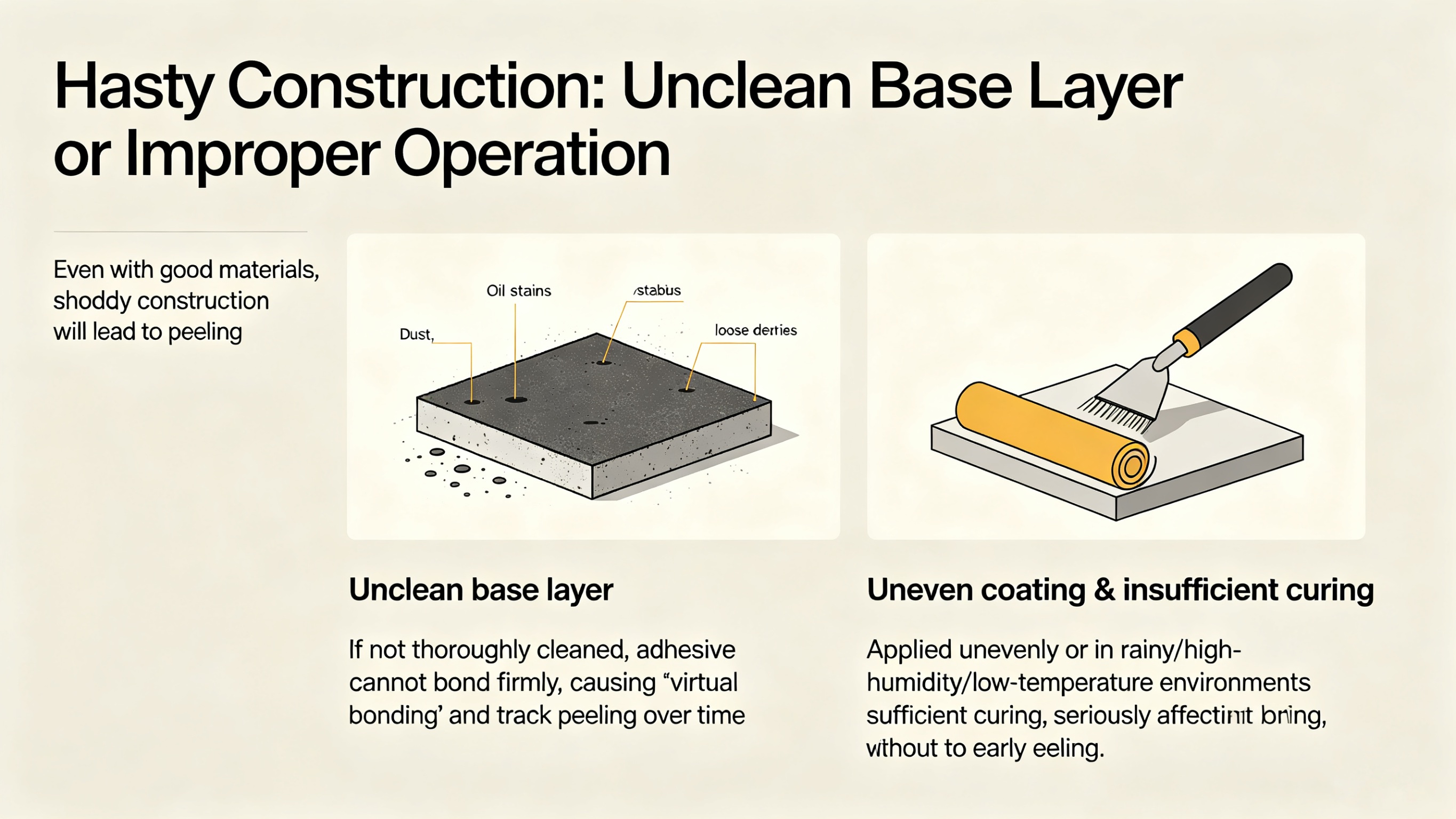
3. Hasty Construction: Unclean Base Layer or Improper Operation
Even with good materials, shoddy construction will lead to peeling.• Unclean base layer: If the concrete or asphalt base layer has dust, oil stains, or loose debris that are not thoroughly cleaned before construction, the adhesive cannot bond firmly with the base layer, resulting in "virtual bonding". Over time, the track will peel off from the base layer.
• Uneven coating & insufficient curing: If the adhesive is applied unevenly, or the construction is carried out in rainy, high-humidity, or low-temperature environments without sufficient curing, the bonding effect will be seriously affected, leading to early peeling of the track.
4. Severe Weathering: Lack of UV and Water Resistance
Low-quality EPDM granules lack professional anti-aging and water resistance treatments.• UV aging: Without UV stabilizers, the EPDM granules will harden and become brittle under long-term sun exposure, losing elasticity and cracking easily.
• Water erosion: Poor water resistance makes EPDM granules absorb water easily. After rain, water infiltrates into the track structure, causing internal expansion and contraction. Repeated freezing and thawing in cold regions will further accelerate the peeling and delamination of the track.
5. Exceeding Load Bearing: Unreasonable Thickness Design
Some projects pursue low costs and reduce the thickness of the EPDM track below the standard (the standard playground track thickness is generally 13mm).• Insufficient thickness: A track that is too thin cannot bear the long-term trampling of a large number of people and vehicles. The stress concentration will cause the surface layer to crack and peel off quickly, seriously shortening the service life of the track.
How to Solve the Peeling Problem of EPDM Tracks?
1. For Existing Peeling Tracks• Local repair: For small-area peeling, clean the loose granules, remove the old adhesive, apply a special EPDM adhesive, and re-lay qualified granules.
• Overall replacement: For large-area peeling and severe delamination, it is recommended to completely remove the old track, re-treat the base layer, and use high-quality EPDM granules and adhesives for re-construction to avoid repeated losses.
2. For New Projects: Choose Premium EPDM Granules to Root Out the Problem
• Select formal manufacturers: Choose factories with complete production qualifications, independent testing capabilities, and export experience to ensure the quality of EPDM granules.
• Check core indicators: Focus on key parameters such as compression recovery rate (≥90%), springback value (≥20mm), tensile strength (≥0.5MPa), and flame retardancy (Class I) of EPDM granules.
• Confirm adhesive matching: Require the construction party to use special EPDM adhesives that match the granules, and supervise the construction process to ensure it meets the standard.
Conclusion
The peeling of EPDM granule tracks is not a natural aging problem, but a direct consequence of using low-quality materials and shoddy construction.
The core solution is to choose high-quality EPDM granules and formal construction teams.
Don't let the high cost of low prices ruin your project. If you are planning to build an EPDM track or need to replace peeling tracks, please contact us.We will provide you with professional EPDM solutions and high-quality products to ensure the long-term safety and durability of your sports ground!
