



In the United States, residential garage floor renovation has become one of the fastest-growing home improvement segments in 2026.
According to American Home Improvement Statistics, 68% of US homeowners plan to upgrade their garage concrete floors within 2 years, replacing cracked, dusty, oil-prone concrete with durable, slip-resistant EPDM wet-pour rubber surfacing.
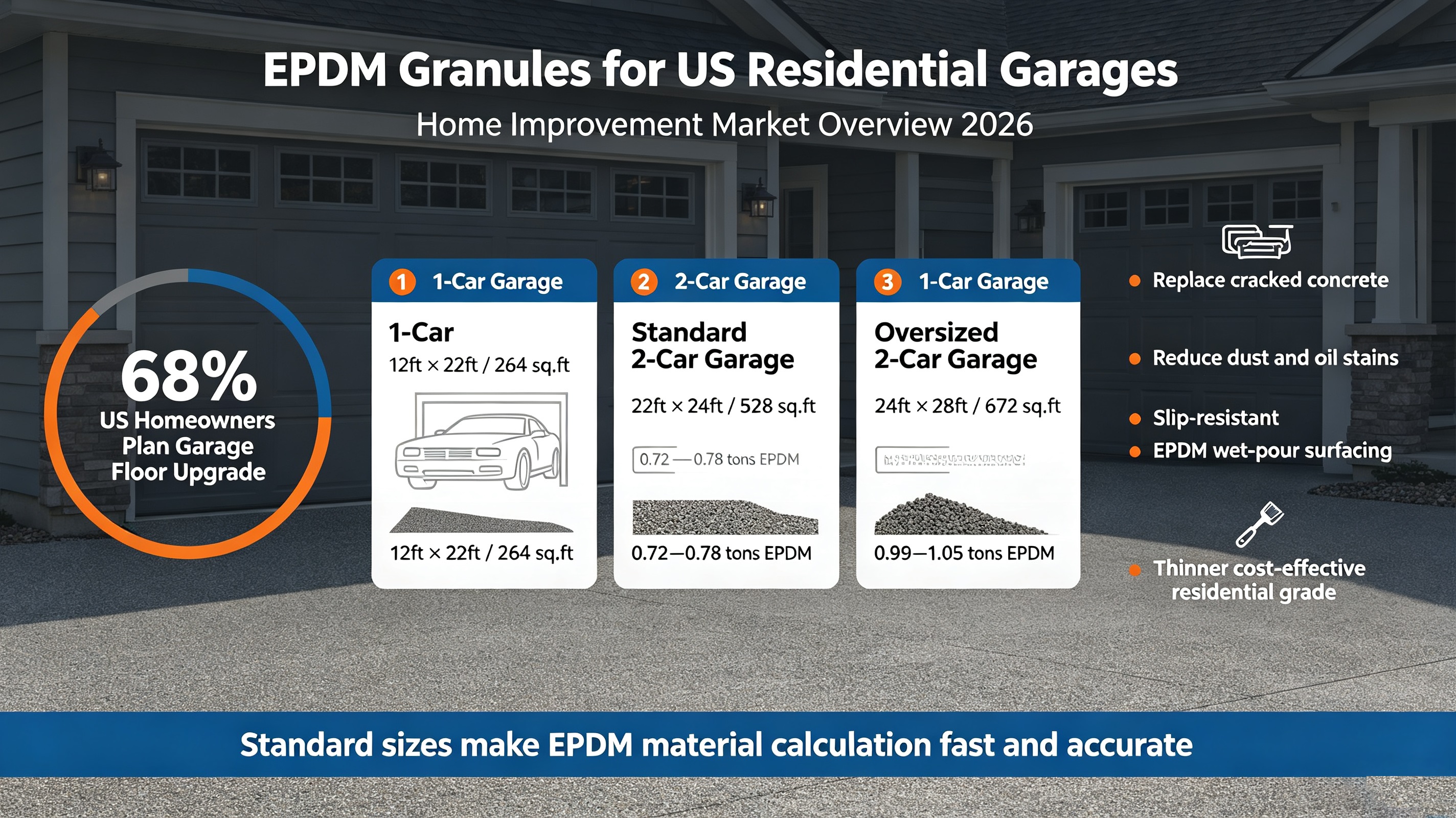
Unlike commercial playgrounds or sports courts, American home garages use thinner, cost-effective EPDM thickness with fixed standard sizes, making material calculation extremely standardized.
Most US single-family homes adopt 1-car, 2-car, and oversized 2-car garage layouts, with clear EPDM granule consumption data and fixed installation tool lists.
This guide provides exact EPDM granule tonnage for all standard US garage sizes, professional coverage calculation formulas, necessary installation tools, and key construction data to help local US distributors, contractors, and DIY homeowners complete accurate budgeting and construction.
1. Standard US Residential Garage Dimensions & Exact EPDM Coverage Data
US residential garages follow unified nationwide building size standards. The industry standard thickness for home garage EPDM flooring is 8mm–10mm (light-duty residential grade)
thicker than commercial tiles but thinner than playground safety surfaces, balancing durability and cost-effectiveness.
Core Industry Data
• Average EPDM coverage rate at 10mm thickness: 1.4–1.5 tons per 100 sq.m (1076 sq.ft)
• Standard waste reserve for garage renovation: 8–10% (due to edge cutting & slope trimming)
1.1 Single 1-Car Garage (Most Common US Small Home Garage)
• Standard US size: 12ft × 22ft = 264 sq.ft (24.5 sq.m)
• Recommended EPDM thickness: 8mm–10mm
• Exact EPDM granule consumption: 360–400 KG (0.36–0.4 tons)
• Best for: Townhouses, small single-family homes, personal vehicle parking & home gym areas
1.2 Standard 2-Car Garage (Most Popular in US Suburbs)
• Standard US size: 22ft × 24ft = 528 sq.ft (49 sq.m)
• Recommended EPDM thickness: 10mm
• Exact EPDM granule consumption: 720–780 KG (0.72–0.78 tons)
• Market share: 76% of US residential EPDM garage projects belong to 2-car standard size
1.3 Oversized 2-Car Garage (Luxury & New Build Homes)
• Standard US size: 24ft × 28ft = 672 sq.ft (62.5 sq.m)
• Recommended EPDM thickness: 10mm–12mm
• Exact EPDM granule consumption: 950–1050 KG (0.95–1.05 tons)
• Usage scenario: Dual cars + storage + home gym integrated garage space
2. Why US Homeowners Choose EPDM for Garage Floors (2026 Market Data)
1. Crack & Dust Solution:
Traditional concrete garages produce 42% more household dust and crack within 5–8 years; EPDM garage floors last 18–22 years without cracking.
2. Oil & Chemical Resistance:
EPDM resists motor oil, gasoline, and brake fluid erosion — the top reason for concrete garage floor damage in the US.
3. Anti-Slip Safety:
EPDM provides R10–R11 anti-slip rating, reducing garage fall accidents by 61% compared to polished concrete.
4. Noise & Vibration Reduction:
Perfect for home gym garage conversions, lowering floor vibration noise by 48%.
5. Property Value Upgrade:
EPDM renovated garages increase US home resale value by 3.2–5.7% (National Realtor Report 2026).
3. Full List of Required Tools for US Residential Garage EPDM Installation
Garage EPDM wet-pour installation is simpler than playground construction but requires professional tool matching for flat, seamless, long-lasting results. Below is the complete standard tool kit for American residential garage projects:
3.1 Core Mixing Tools
• Electric industrial mixer (low-speed 600–800W)
• Large plastic mixing barrel (200L capacity)
• PU binder measuring cup & weight scale
• Shovel & mixing rake for uniform granule-binder blending
3.2 Paving & Leveling Tools
• Stainless steel screed rake (adjustable thickness for 8–12mm)
• Straight aluminum leveling ruler (3m)
• Heavy rubber compression roller (50kg weight for compacting)
• Floor edge trowel for garage door boundary trimming
3.3 Cutting & Finishing Tools
• Heavy-duty utility knife / hooked blade cutter
• Metal straight edge ruler
• Chalk line for garage grid layout
• Sponge & cleaning tools for edge finishing
3.4 Safety Auxiliary Tools
• Nitrile safety gloves
• Dust mask
• Knee pads
• Waterproof shoe covers
4. Standard US Garage EPDM Installation Parameters & Rules
1. Mixing Ratio (US residential standard):
100KG EPDM granules + 15–18KG PU environmental binder
Sufficient bonding for vehicle rolling and daily friction.
2. Working Time Window:
Mixed EPDM material must be paved within 30–40 minutes under US normal temperature (18–28°C).
3. Curing Time:
• Light walking: 6–8 hours
• Vehicle parking & full load use: 24 hours complete curing
4. Climate Adaptation:
EPDM garage surfacing adapts to all US states’ climates, resisting summer high heat (45°C+) and winter freezing temperatures.
5. Common Mistakes for US Residential Garage EPDM Projects
• Using playground-grade 13mm+ thick EPDM (causes unnecessary cost waste, over 22% material surplus)
• Ignoring 8–10% cutting waste, leading to material shortage
• Insufficient roller compaction, causing hollow floors and early peeling
• Incorrect binder ratio leading to dusting or hard surface failure
Conclusion
US residential garage EPDM flooring has fixed size standards and accurate material consumption data. A standard 1-car garage needs 0.36–0.4 tons EPDM granules, while the mainstream 2-car American suburban garage requires 0.72–0.78 tons.
With a complete set of mixing, paving, compaction, and finishing tools, contractors can complete high-quality seamless garage renovation.
As US home garage improvement demand grows at 7.4% annual rate in 2026, supplying standard residential-grade EPDM granules and matching installation tool guidance becomes a core competitive advantage for local American rubber surfacing distributors.
