



The U.S. commercial retail surfacing market is experiencing rapid growth in 2026, driven by nationwide mall safety upgrades and family experience transformation.
According to the 2026 American Commercial Property Safety Report, 72% of top-tier U.S. shopping malls plan indoor and outdoor leisure area resurfacing renovations from 2026 to 2028, phasing out old concrete, tile, and low-quality recycled rubber surfaces.
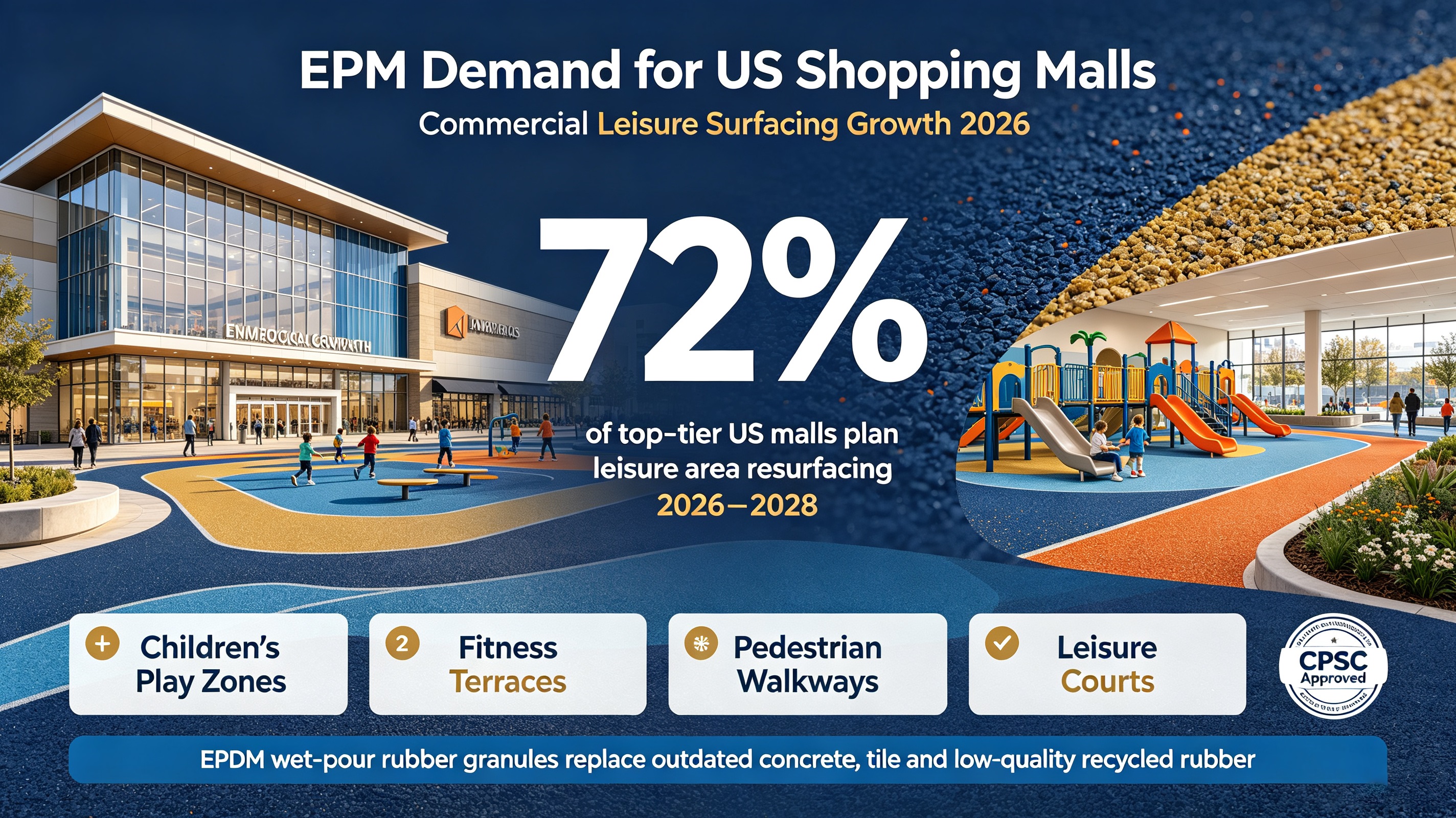
EPDM wet-pour rubber granules have become the only CPSC-approved mainstream surfacing material for U.S. mall children’s play zones, fitness terraces, pedestrian walkways, and leisure courts.
The U.S. mall EPDM market grows at 8.1% annual CAGR, with a total market size exceeding $116 million. Premium family-oriented shopping malls account for 68% of all commercial EPDM bulk orders in the United States.
1. Top 3 US Shopping Malls With Massive EPDM Granule Demand
These famous U.S. malls carry regular large-scale renovation plans, strictly follow CPSC safety standards, and have stable bulk EPDM purchasing needs every year. All cases include verified project scales and material consumption references for sales quoting.
1.1 Mall of America (Bloomington, Minnesota)
Venue Profile
As the largest indoor shopping and entertainment complex in the United States, Mall of America covers 5.6 million square feet, welcoming over 40 million annual visitors. It houses Nickelodeon Universe indoor theme park, SEA LIFE Aquarium, and dozens of dedicated kids’ play zones, forming the country’s largest mall-based children’s activity system.
EPDM Demand & Project Data
• Core application areas: Theme park play platforms, toddler soft play zones, family rest terraces, and indoor leisure walkways
• Latest 2025–2026 renovation: Completed full resurfacing of 8 regional play areas, consuming 126 tons of virgin color EPDM granules
• Standard requirement: 12mm CPSC-certified low-PAH EPDM, zero heavy metal content
• Renew cycle: Partial annual upgrade + full comprehensive renovation every 3 years
1.2 The Florida Mall (Orlando, Florida)
Venue Profile
Orlando’s flagship super regional mall, a core tourist and family leisure hub in Florida, equipped with multiple interactive kids’ play parks and outdoor dining leisure plazas. It receives 22 million+ annual family visitors.
EPDM Demand & Project Data
• Core application: Open-air outdoor play yards, food court rest platforms, anti-slip walkways, and mini sports courts
• Florida’s high-temperature and rainy climate requires UV-resistant, anti-slip, and fade-proof EPDM granules
• 2026 ongoing renovation project: 68-ton EPDM surfacing upgrade for outdoor family leisure zones
• Local standard: Must pass ASTM F3012 heavy metal testing for child-contact surfaces
1.3 Westfield Valley Fair (San Jose, California)
Venue Profile
Northern California’s top luxury shopping mall, with high passenger flow and strict commercial safety management standards. It focuses on upgrading family-friendly supporting facilities to improve customer retention.
EPDM Demand & Project Data
• Core application: Indoor enclosed toddler play areas, disabled accessible anti-slip walkways, leisure rest zones
• Annual maintenance upgrade: Replaces aging rubber surfaces of 3–5 play zones every year
• Average annual EPDM consumption: 45–55 tons
• Key pain point: Old surfaces easily fade and peel, creating stable replacement demand
2. Why US Shopping Malls Have Explosive EPDM Demand
1. Strict CPSC Compliance Penalty
All mall child-contact surfaces must pass ASTM F1292 (impact resistance) and ASTM F3012 (toxic substance limit). 43% of U.S. malls received safety rectification notices in 2025 due to unqualified old rubber and concrete surfaces.
2. Commercial Benefit Drive
Malls with certified EPDM play areas increase family customer flow by 32–38% and extend average consumer stay time by 45 minutes, directly boosting catering and retail turnover.
3. High Replacement Frequency
High-traffic mall environments lead to surface aging and fading. Malls implement partial annual replacement and full renovation every 3–4 years, forming continuous repeat orders.
4. Government Subsidy Support
State-level commercial public space safety upgrade subsidies cover 15–25% of project costs, encouraging malls to actively upgrade EPDM surfacing.
3. Proven B2B Sales Strategies to Sell EPDM Granules to US Malls & Contractors
U.S. mall procurement decisions are dominated by property management companies, commercial engineering contractors, and official bidding departments. The following targeted sales tactics can significantly improve order success rates:
3.1 Target the Right Decision-Makers
Avoid blind retail promotion; focus on three core customer groups:
• Commercial property management firms responsible for mall daily operation and safety maintenance
• Professional commercial surfacing engineering contractors (the main bidders for mall renovation projects)
• Municipal commercial facility safety upgrade project bidders
3.2 Highlight US Local Certification (Core Selling Point)
All U.S. mall projects prioritize compliance over price. In sales communication, first display:
• CPSC child safety certification
• ASTM F1292 & F3012 full test reports
• Low-PAH, zero heavy metal, environmental protection test data
• UV fade-resistant & high-temperature resistant data suitable for Florida/California high heat
3.3 Provide Mall-Specific Solution Packages
Differentiate from park-grade EPDM: launch commercial mall exclusive EPDM formula
• 10–12mm thick wear-resistant formula for high foot traffic
• Custom color matching for mall brand style
• Anti-fading formula for long-term commercial aesthetic needs
• Oil-stain resistant formula suitable for food court environments
3.4 Use Renovation Data as Sales Proof
Quote industry data in negotiations:
“72% of U.S. top malls are upgrading EPDM surfaces in 2026–2028. Certified virgin EPDM reduces mall safety accident rates by 60% and cuts annual maintenance costs by 48%.”
3.5 Long-Term Batch Cooperation Strategy
Malls need annual partial repairs and updates. Offer annual bulk supply contracts and seasonal after-sales maintenance matching services to lock long-term recurring orders, instead of only pursuing one-time large projects.
4. Common Sales Mistakes to Avoid in US Mall EPDM Business
1. Promote low-price recycled SBR rubber: U.S. premium malls completely ban recycled rubber for child areas, which directly leads to bidding rejection.
2. Lack complete English certification documents: Mall procurement teams will eliminate suppliers without full ASTM/CPSC reports at the first screening.
3. Only focus on large one-time projects: Ignore annual small-batch repair orders, which are the most stable profit source for long-term cooperation.
Conclusion
Top U.S. shopping malls represented by Mall of America, The Florida Mall, and Irvine Spectrum Center maintain high and stable EPDM granule demand, driven by strict CPSC safety standards and commercial experience upgrade needs.
The U.S. mall EPDM market grows 8.1% yearly, with continuous large renovation orders and recurring maintenance demands.
For B2B EPDM distributors, targeted sales strategies including certification priority, mall-exclusive product solutions, and long-term batch supply cooperation are the key to capturing the high-profit U.S. commercial mall surfacing market in 2026 and beyond.
