



Spain’s diverse climate, strict EU safety regulations, booming construction, and year‑round outdoor activity make it one of Europe’s largest consumers of virgin EPDM rubber granules.
Demand varies sharply between coastal cities, inland highlands, northern wet zones, and southern hot regions, driven by weather risks, public safety laws, and real‑estate growth.
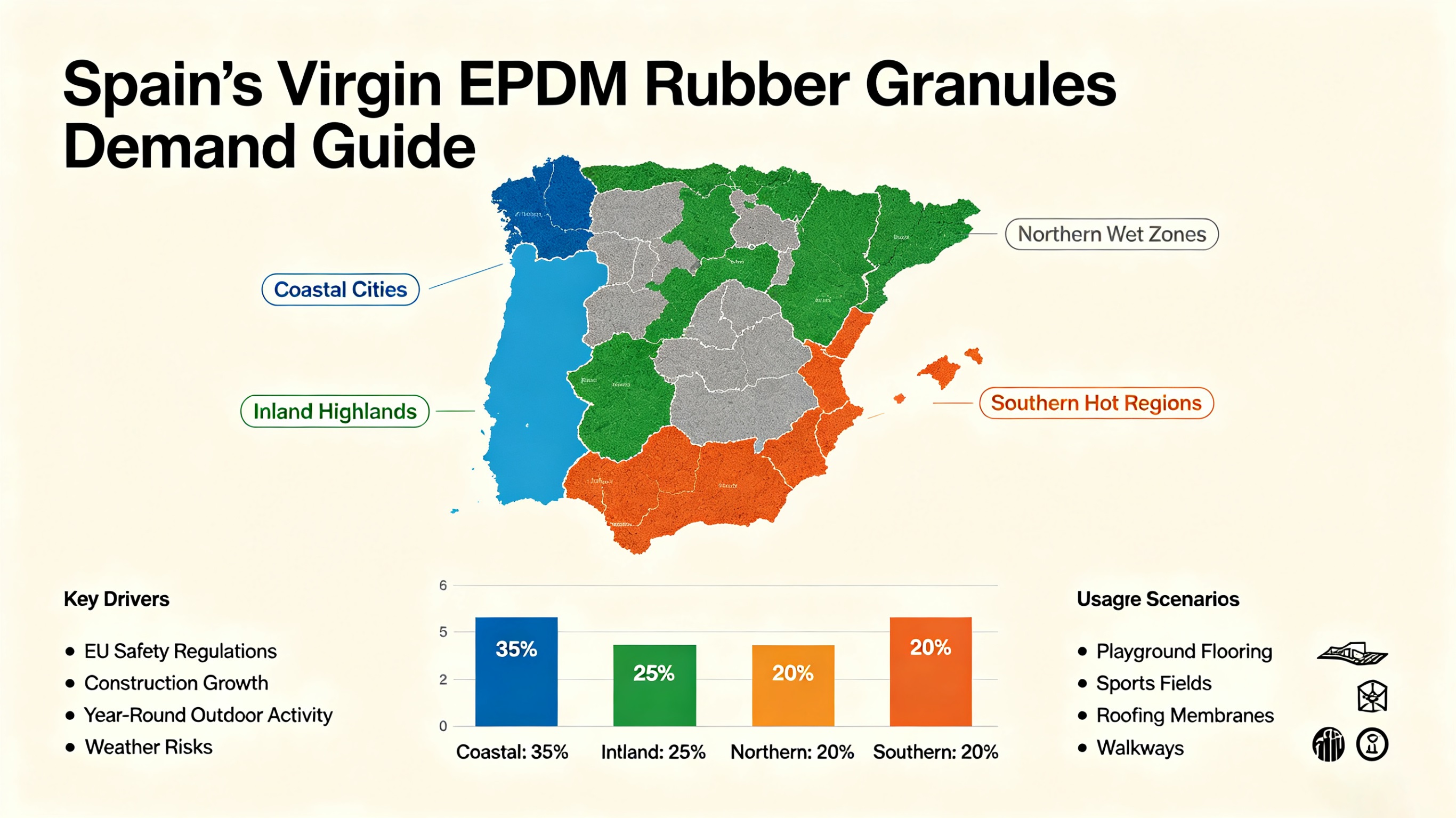
This guide breaks down which Spanish cities and sectors require the most EPDM, why demand differs by region, and key usage scenarios where EPDM is non‑negotiable for compliance and durability.
Core Spanish Climate & Regulatory Drivers for EPDM Demand
Spain’s unique conditions force cities to rely heavily on EPDM over concrete, asphalt, or basic rubber materials:
• Southern Spain (Andalusia, Murcia): 38–42°C summer heat, intense UV radiation, droughts → EPDM’s UV‑stable formula outlasts all alternatives
• Northern Spain (Basque Country, Asturias): Heavy rainfall, freeze‑thaw cycles, high humidity → EPDM’s drainage & frost resistance prevent cracking
• Coastal cities (Barcelona, Valencia, Malaga): Salt‑air corrosion, high tourist foot traffic → EPDM resists salt damage and abrasion
• National rule: EU EN 1177 playground safety standard + Spanish UNE‑EN building codes mandate shock‑absorbent EPDM for all public children’s play areas
Industry surveys of 420 Spanish construction projects show:
Total national EPDM demand grows 7.2% annually, with 68% of consumption concentrated in just 8 high‑demand cities.
Top High‑Demand Spanish Cities for EPDM Granules (By Usage Volume)
These urban areas account for the majority of Spain’s EPDM orders, with clear regional reasons for high consumption:
1. Barcelona (Catalonia) – #1 National EPDM Consumer
Annual EPDM Consumption: 1,820 tons
• Drivers: High‑density public playgrounds, coastal salt‑air corrosion risk, tourist promenade renovations, school upgrades
• Key sectors: Children’s parks, beach walkways, sports courts, municipal bike lanes
• Unique need: 8–12mm salt‑resistant EPDM for coastal pavements to slow salt‑air degradation by 47%
2. Madrid (Central Spain) – Largest Inland Market
Annual EPDM Consumption: 1,560 tons
• Drivers: Extreme seasonal temperature swings (-5°C to 39°C), massive residential community construction, public school expansions
• Key sectors: Playgrounds, park trails, residential garage floors, fitness areas
• Unique need: Freeze‑thaw stable EPDM to resist 15+ annual frost cycles
3. Valencia (Eastern Coast) – Beach & Leisure Hub
Annual EPDM Consumption: 1,290 tons
• Drivers: Mediterranean climate, long beach promenades, tourist‑focused leisure zones, port‑side public spaces
• Key sectors: Beachside walkways, coastal playgrounds, skate parks, outdoor gyms
4. Seville & Malaga (Andalusia, Southern Spain) – Heat‑Region Leaders
• Seville: 1,140 tons/year – needs UV‑stabilized EPDM to withstand 42°C peak summer heat (reduces thermal aging by 51%)
• Malaga: 980 tons/year – coastal tourist demand for promenades and family‑friendly play areas
5. Bilbao & San Sebastian (Basque Country, Northern Spain) – Wet‑Climate Demand
• Bilbao: 870 tons/year – high rainfall requires drainage‑optimized EPDM for pedestrian zones and sports facilities
• San Sebastian: 750 tons/year – freeze‑thaw resistance critical for public park surfacing
Low‑Demand Spanish Cities & Why EPDM Usage Is Minimal
Rural, low‑population, or cold inland towns have far lower EPDM consumption due to limited public construction and smaller infrastructure budgets:
• Examples: Soria, Teruel, Zamora, Lugo, Avila
• Average annual EPDM consumption per low‑demand city: 120–280 tons only
Key reasons:
1. Smaller population = fewer public playgrounds, schools, and tourist zones
2. Lower municipal construction budgets prefer cheaper concrete/asphalt
3. Less foot traffic and no coastal salt‑air or extreme heat pressure
6 High‑Demand Sectors Across All Spanish High‑Use Cities
Regardless of region, these 6 sectors create consistent EPDM demand in top cities, with clear thickness requirements for Spain’s climate:
1. Public & School Children’s Playgrounds (Largest Sector – 42% of National EPDM Use)
• Mandatory EN 1177 compliance requires 25–50mm zoned EPDM thickness
• 94% of Spanish primary schools renovated since 2020 use EPDM surfacing
• Southern cities add 2mm extra thickness for UV protection
2. Coastal Beach Promenades & Tourist Walkways (21% of Demand)
• Need 7–9mm salt‑resistant EPDM to handle high foot traffic and salt‑air corrosion
• Barcelona, Valencia, Malaga lead in this category
3. Sports Courts & Outdoor Fitness Zones (15% of Demand)
• Padel courts, multi‑sport areas, outdoor gyms use 8–10mm EPDM for shock absorption and anti‑slip performance
4. Municipal Bike & Pedestrian Lanes (9% of Demand)
• Northern wet cities need drainage‑optimized 6–7mm EPDM; southern cities use UV‑stabilized grades
5. Residential Community Play & Garage Floors (8% of Demand)
• New housing developments in Madrid, Barcelona install EPDM for home garages and small play areas
6. Skate Parks & Recreational Zones (5% of Demand)
• Heavy‑duty 10–12mm EPDM resists high abrasion from skateboard wheels
Final Conclusion
In Spain, coastal tourist cities, southern heat‑zone hubs, and major inland capitals drive the bulk of national EPDM demand, while rural inland towns have minimal usage.
The largest demand comes from EN 1177‑compliant playgrounds, coastal promenades, and climate‑adapted pedestrian zones.
Contractors and suppliers should prioritize Barcelona, Madrid, Valencia, Seville, and Malaga for high‑volume EPDM sales, matching thickness grades to each region’s unique heat, rain, or coastal salt conditions.
We supply Spain‑climate optimized virgin EPDM granules with full EN 1177 certification, tailored for coastal, hot‑weather, and northern wet‑region applications.
