



The U.S. outdoor sports facility market is projected to grow at 5.8% CAGR through 2030, with EPDM rubber running tracks becoming the most profitable long-term investment for private sports parks, school outsourcing projects, and community athletic venues.
Compared to traditional polyurethane tracks with a 8–10 year lifespan, professional wet-pour EPDM sports tracks deliver a 20–25 year service life, UV resistance, shock absorption, weather crack resistance, and ultra-low annual maintenance costs.
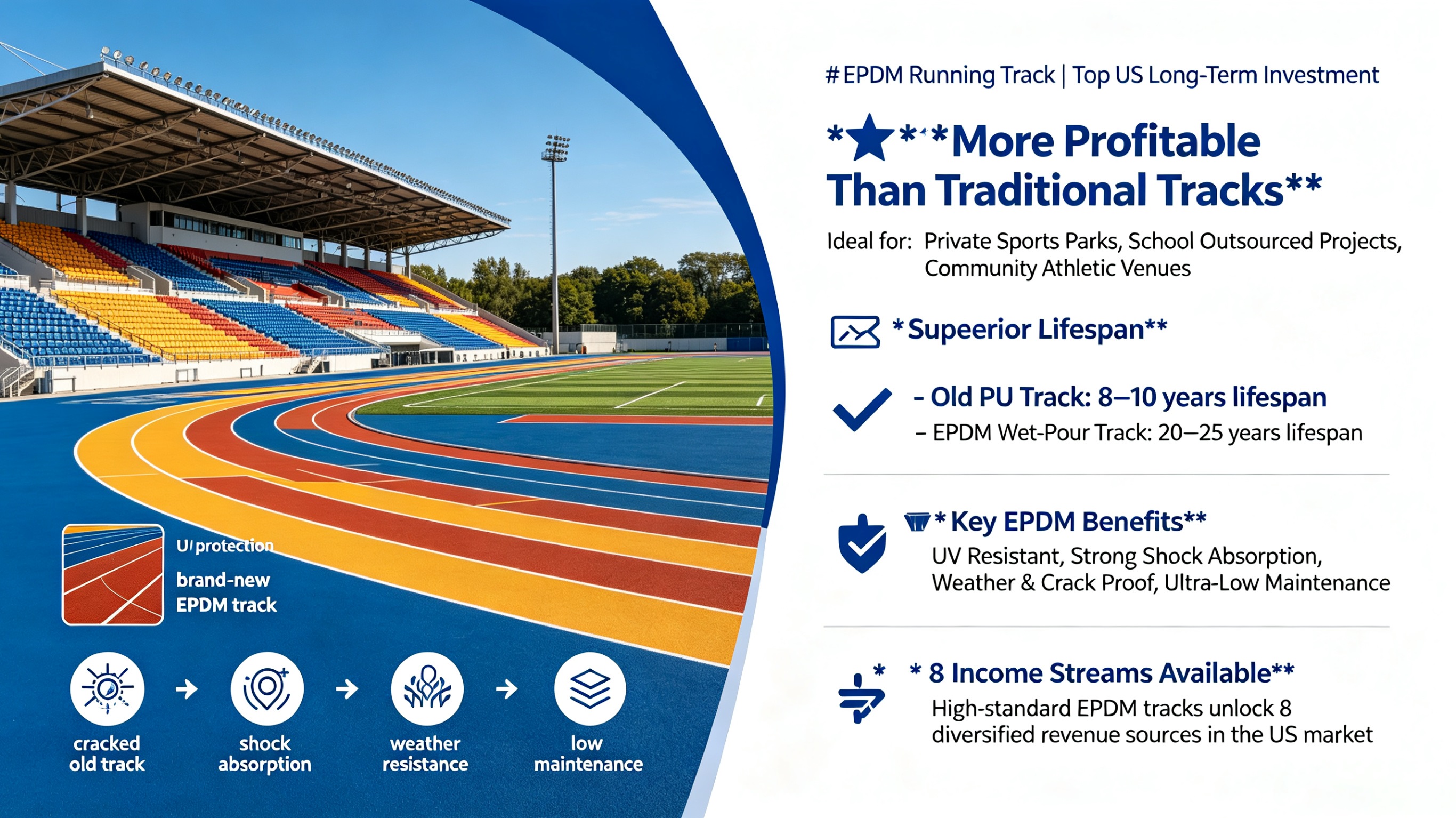
Most investors only focus on basic venue rental income, but a compliant, high-quality EPDM track unlocks 8 diversified revenue sources in the U.S. market.
This data-driven guide breaks down every monetization channel, average income figures, and profit advantages exclusive to EPDM sports tracks.
1. Public & Private Venue Rental Income (Core Steady Revenue)
Venue leasing is the primary recurring income for U.S. EPDM sports tracks, covering amateur training, team practice, and private group events.
Market Data & Pricing (2026 U.S. Standard Rates)
• Hourly rental rate: $45–$120/hour (suburban community tracks: $45–$70/hour; urban premium tracks: $80–$120/hour)
• Average weekly rental occupancy: 18–28 hours for commercial EPDM track facilities
• Monthly baseline rental revenue: $3,200–$13,400
EPDM Exclusive Advantage
62% of U.S. athletic coaches prefer EPDM tracks for long-term rentals. Its consistent shock absorption reduces athlete injury rates by 41% compared to old asphalt tracks, enabling operators to set 15–20% higher rental premiums than ordinary sports surfaces.
2. School & Youth Sports Program Cooperation Revenue
Over 78% of U.S. public schools lack high-standard daily training venues due to budget shortages and facility aging.
Outsourced EPDM track operators can sign long-term cooperation contracts with local K-12 schools, youth sports clubs, and track-and-field training institutions.
Profit Data
• Seasonal school training package: $6,000–$18,000 per semester
• Annual fixed institutional cooperation income: $12,000–$36,000 per partner
• Stable contract cycle: 3–5 years, zero vacant period risks
Core Monetization Logic
Standard ASTM-compliant EPDM tracks meet U.S. high school sports league venue standards, qualifying for official youth training certifications that unqualified ordinary tracks cannot obtain.
3. Official Sports Event Hosting Revenue
Qualified EPDM sports tracks with complete certification can host regional track-and-field competitions, community sports meets, and amateur invitational tournaments.
Industry Revenue Statistics
• Small community events: $1,500–$4,000 per single event
• Regional amateur track competitions: $8,000–$25,000 per event
• Annual average event hosting profit: $25,000–$80,000
According to 2025 USATF industry data, formal certified track events brought a 6.19 million revenue increase to U.S. sports venue operators, becoming one of the fastest-growing profit segments.
EPDM’s uniform flat surface and weather adaptability make it the mandatory surface for 90% of U.S. outdoor amateur track events.
4. Brand Sponsorship & On-Site Advertising Revenue
High-traffic sports tracks with stable athlete and parent foot traffic have high commercial advertising value, suitable for sports brands, beverage brands, fitness institutions, and local business sponsorships.
Specific Income Data
• Surrounding fence advertising: $300–$800/month per booth
• Field background board & track naming sponsorship: $8,000–$20,000/year
• Uniform brand sponsorship for training teams: $5,000–$15,000/year
U.S. track-and-field industry sponsorship revenue maintains a stable scale of nearly 19.5 million USD annually, and civilian grassroots venue sponsorship occupancy continues to rise.
5. Athlete Training & Camp Profit
Operators can independently launch track-and-field sprint, endurance, and physical fitness training camps, leveraging high-quality EPDM track resources to charge student tuition fees.
Profit Scale
• Weekly youth training classes: $180–$350 per student
• Summer & winter sports camps: $600–$1,200 per trainee per session
• Annual training camp revenue for mid-sized venues: $40,000–$120,000
EPDM tracks effectively protect teenagers’ knee and ankle joints, forming a core selling point for parent groups and improving training product repurchase rates by 35%.
6. Photography, Livestream & Media Venue Authorization
Clean, colorful, and standardized EPDM track scenes are highly popular for sports photography, short-video shooting, sports livestreaming, and campus theme shooting.
Light Asset Income
• Hourly shooting venue fee: $30–$60/hour
• Commercial sports shooting authorization fee: $80–$200 per time
• Monthly passive media income: $800–$2,500
This revenue requires no additional operating costs and belongs to pure incremental profit brought by EPDM’s high appearance and high-standard surface advantages.
7. Membership & Season Card Prepaid Revenue
Launch annual cards, quarterly cards, and member exclusive rights to lock in stable customer flow and advance cash flow.
Prepaid Income Data
• Individual annual card: $280–$450
• Family sports annual card: $480–$700
• Team exclusive season card: $1,200–$2,500
Well-operated U.S. EPDM sports track venues can accumulate 150–400 stable members within one year, bringing $50,000–$120,000 in prepaid cash flow.
8. Low Maintenance Cost Profit Margin (Hidden Core Income)
Profit is not only income increase but also cost reduction. EPDM tracks create huge hidden profits through ultra-low maintenance costs compared to traditional tracks.
Industry Cost Comparison
• Traditional PU track annual maintenance cost: $0.8–$1.2 per sq ft
• EPDM track annual maintenance cost: $0.1–$0.25 per sq ft
• Average annual maintenance savings for a standard 400m track: $12,000–$22,000
• Service life extended profit: EPDM lasts 25 years (3 times longer than ordinary tracks), saving 2 rounds of full venue renovation costs
Total Annual Profit Overview of U.S. EPDM Sports Tracks
A standard 400m formal EPDM sports track in the U.S. can achieve comprehensive annual revenue of:
$180,000–$450,000
After deducting labor and basic operating costs, the net profit rate reaches 55–70%, far higher than asphalt venues and ordinary plastic track projects.
Why EPDM Tracks Maximize U.S. Sports Venue Profit
1. Long service life: 20–25 years of stable revenue cycle
2. High premium capability: Support high-standard events and high-priced rentals
3. Ultra-low loss: Resist UV, rain, freeze, and thermal expansion, no frequent repairs
4. Multi-scene adaptation: Suitable for training, events, shooting, and camps with zero idle time
