



The United Kingdom features unique and challenging outdoor weather conditions, including frequent rainfall, persistent humidity, winter frost, strong seasonal winds, and changeable UV radiation.
These harsh climatic factors place strict demands on outdoor sports surfaces, especially standard tennis courts.
Unlike playgrounds or running tracks, tennis courts require a precise balance of firm rebound, consistent ball speed, anti-slip performance, and long-term structural stability.
Choosing the correct EPDM granule thickness tailored for UK weather is the key to avoiding slippery surfaces, water pooling, premature cracking, and uneven court deformation.
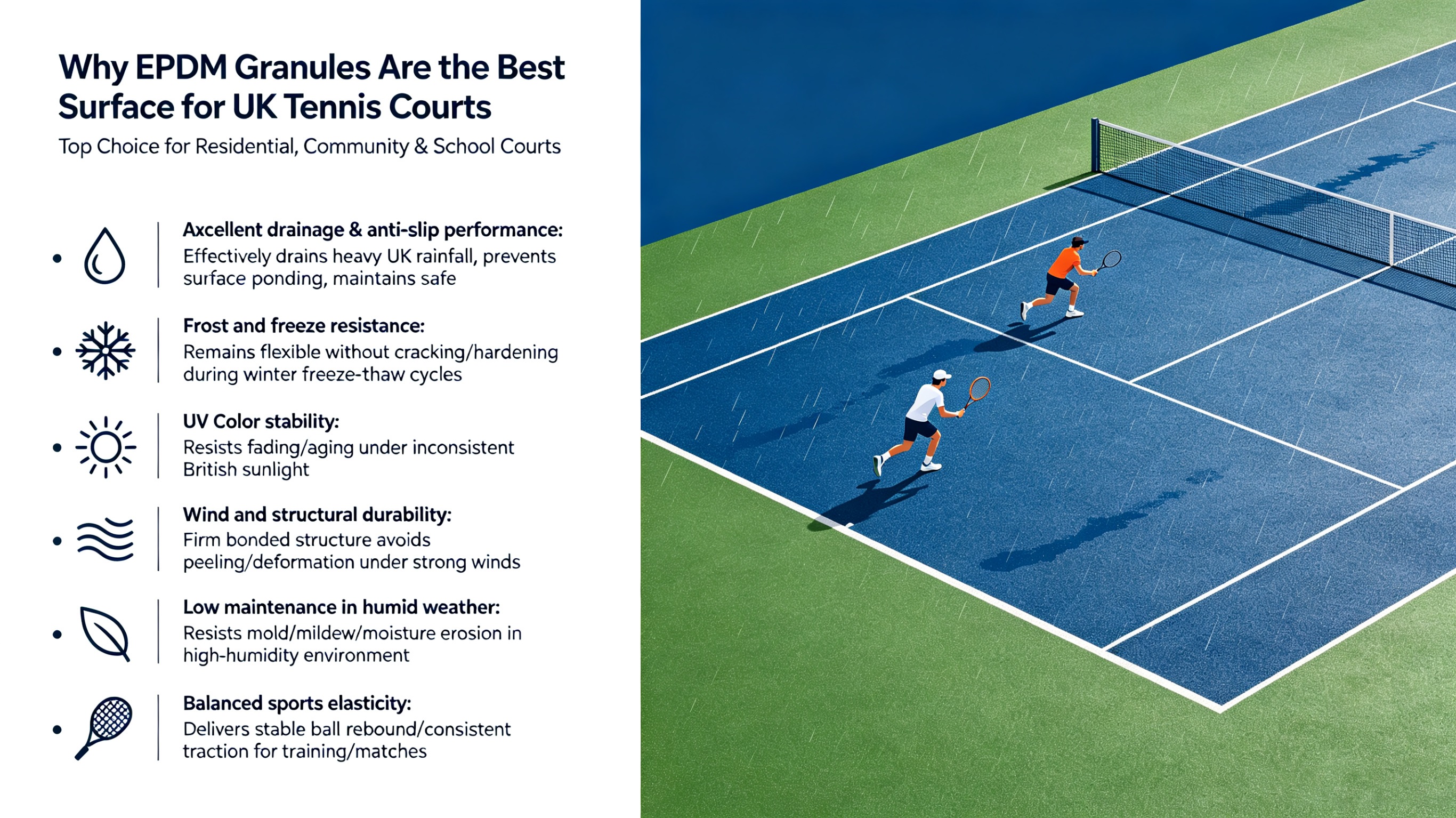
Why EPDM Granules Are the Best Surface for UK Tennis Courts
Traditional tennis court surfaces easily degrade under the UK’s damp and frosty climate.
EPDM rubber granules have become the top choice for UK residential, community, and school tennis courts for their outstanding weather-resistant and sports-performance features:
• Excellent drainage & anti-slip performance: Effectively drains heavy UK rainfall, prevents surface ponding, and maintains safe grip for players on wet days
• Frost and freeze resistance: Remains flexible without cracking or hardening during UK winter freeze-thaw cycles
• UV color stability: Resists fading and surface aging under inconsistent British sunlight all year round• Wind and structural durability: Firm bonded structure avoids peeling or deformation under strong seasonal winds
• Low maintenance in humid weather: Resists mold, mildew, and moisture erosion in the UK’s high-humidity environment
• Balanced sports elasticity: Delivers stable tennis ball rebound and consistent running traction for daily training and casual matches
Standard EPDM Thickness for UK Tennis Courts (Weather & Usage Classified)
Tennis court EPDM thickness cannot adopt universal standards.
It must be adjusted according to UK rainy, frosty weather and different usage scenarios to balance sports performance, weather durability, and cost efficiency. Below are the most authoritative thickness specifications for British standard tennis courts:
1. Private Residential Domestic Tennis CourtsRecommended EPDM Thickness: 8–10mm
Perfect for backyard tennis courts, private garden courts, and low-frequency family use across England, Wales, and Scotland.
This thickness is the most cost-effective option for UK household tennis facilities.
The compact 8–10mm EPDM layer provides standard tennis ball rebound strength, fast rainwater drainage, and basic frost resistance. It avoids excessive softness that slows down ball speed and effectively resists daily damp weather erosion, fully meeting daily family entertainment and casual practice needs.
2. Community & School Standard Tennis Courts (Most Popular in UK)
Recommended EPDM Thickness: 10–12mmThis is the official standard thickness for most UK public community courts, primary and secondary school sports courts, and local leisure centers.
Facing high-frequency daily use, crowd trampling, and long-term exposure to UK rainy and humid weather, the 10–12mm thick EPDM layer enhances overall surface durability. It prevents fine particle shedding, water penetration, and internal layer aging caused by continuous rainfall. Meanwhile, it maintains standardized tennis bounce performance and anti-slip safety, adapting to year-round British outdoor weather changes.
3. Professional Training & Competition-Level Tennis Courts
Recommended EPDM Thickness: 12–14mm
Designed for UK sports clubs, professional training bases, and small-scale official tennis matches.
The thicker 12–14mm compacted EPDM structure delivers superior impact resistance and structural stability.
It can withstand intensive high-speed running, sudden braking, and frequent ball hitting without surface deformation.
In harsh UK coastal areas with strong winds, salt moisture, and severe winter frost, this thickness effectively extends the court service life and maintains consistent professional sports performance for years.
How UK Weather Determines Tennis Court EPDM Thickness
1. Frequent annual rainfall: The UK’s long rainy seasons require medium-thick compact EPDM to prevent water seepage, internal bubbling, and layer separation. Too-thin EPDM easily accumulates water and becomes slippery after rain.
2. Winter frost and low temperature: British winter freeze-thaw cycles damage thin rubber surfaces. Standard 8mm+ EPDM layers keep flexible and crack-free in cold weather.
3. High atmospheric humidity: Long-term damp air causes mold and aging on thin sports surfaces. Thicker dense EPDM resists moisture erosion and keeps the court intact all year round.
4. Strong outdoor winds: Proper thickness ensures the EPDM bonding layer is firm, avoiding particle peeling and edge warping under UK seasonal strong winds.
UK Weather-Adapted EPDM Tennis Court Installation & Maintenance Tips
• Reserve a tiny surface gradient during installation to accelerate rainwater drainage, eliminating ponding risks in UK rainy weather• Adopt UK weather-grade polyurethane binder with strong frost resistance and waterproof adhesion
• Choose UV-stable classic tennis court colors (red, green, blue) to prevent fading under changeable UK sunlight
• Compact the EPDM granules evenly to enhance overall wind resistance and freeze-thaw stability
• Conduct regular surface cleaning to remove fallen leaves, dust, and stains, avoiding damp corrosion and particle hardening
Final Summary
For standard EPDM tennis courts adapting to UK weather:• Private residential tennis courts: 8–10mm EPDM
• Community & school public tennis courts: 10–12mm EPDM
• Professional training & competition tennis courts: 12–14mm EPDM
Matching the correct EPDM thickness to British climate characteristics ensures stable tennis sports performance, maximum weather durability, and a service life of over 10 years for outdoor courts.
As a professional EPDM granule manufacturer for UK sports facilities, we provide weather-customized, UV-stable, frost-resistant EPDM granules and professional technical guidance for all standard UK tennis court projects.
