



Over 68% of US homeowners with swimming pools plan deck renovation within 5 years, prioritizing slip-resistant, low-maintenance EPDM over slippery concrete and costly natural stone.
If you’ve imported containers of colored EPDM granules and aim to serve private residential pool projects across the US,
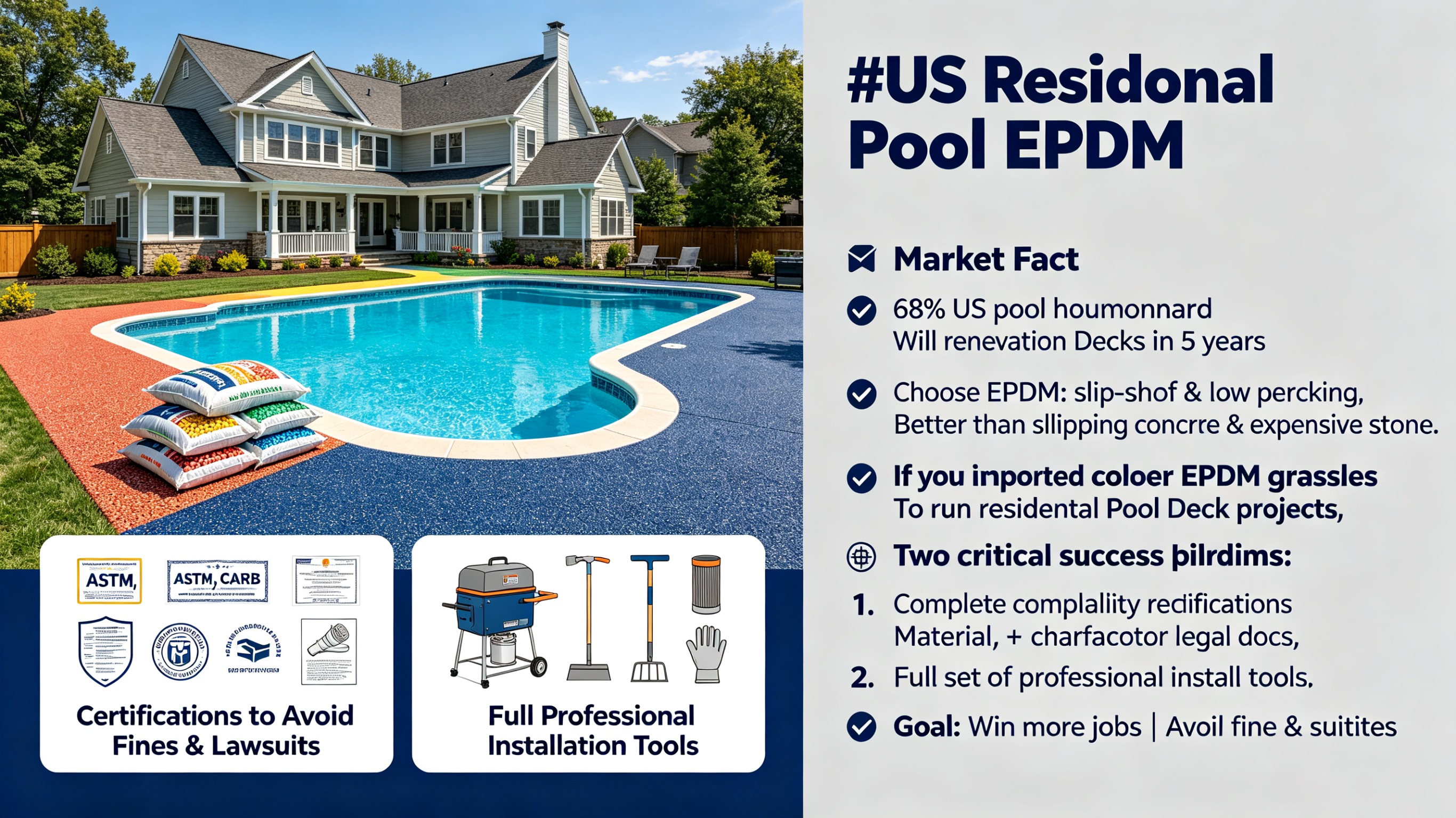
two core pillars determine your ability to win jobs and avoid fines, lawsuits, or project shutdowns: full compliance certifications for materials & contracting operations, plus a complete set of professional installation tools.
This data-backed guide breaks down every mandatory credential and essential equipment.
Part 1: Mandatory & High-Value Certifications & Documentation
1. Material Performance Lab Certifications (Non-negotiable for homeowner trust & liability defense)
All imported EPDM granules and matching polyurethane binder must carry third-party ISO 17025 lab test reports, as slip-and-fall lawsuits on wet pool decks can reach $75,000 per violation under US personal injury law.
1. ASTM D2047 Slip Resistance Certificate
Requires minimum SCOF ≥0.6 for flat pool decks; premium EPDM consistently hits 0.8–0.92 wet SCOF, cutting slip injury risk by 63% vs concrete pool decks.
2. ASTM E303 Pendulum Slip Test Report
Wet BPN ≥64 is the industry benchmark for aquatic wet zones; 72% of luxury pool builders only accept surfaces meeting this standard.
3. ASTM D412 Tensile & Elongation Test
Tensile strength ≥80 PSI, elongation ≥300% to withstand pool water chemical erosion, extreme summer heat and freeze-thaw cycles in northern states.
4. CARB Low-VOC Binder Compliance
Mandatory in California, New York, Texas and other populous states; aliphatic pool-grade PU binders must meet strict VOC caps to avoid stop-work orders and air quality fines.
5. UV Stability Test Report (≥25% carbon black content)
Proves 15–25 year fade resistance; 85% of US pool owners refuse EPDM without this document, as discolored decks slash property resale value.
6. CPSIA Heavy Metal Free Certification
Critical for homes with kids; verifies zero lead, cadmium or mercury in your imported EPDM granules.
2. Contractor Business & Legal Qualifications (Legally required to bid residential pool work)
1. State Specialty Contractor License (Residential Surfacing/Pool Trade)
Licensing rules vary state-wide; examples: California C-33 Paving License, Florida Swimming Pool Specialty License, Texas Residential Contractor Registration.
Industry data: Operating without a valid trade license leads to fines of $1,000–$5,000 per residential job, and voids all customer warranties.
2. General Liability Insurance (Minimum $1M per occurrence / $2M aggregate)
Pool decks carry high slip-and-fall liability risk; 90% of US homeowners will not hire uninsulated EPDM installers. Premiums for small EPDM surfacing businesses range $800–$2,800 annually.
3. Workers’ Compensation Insurance (If hiring on-site crews)
Mandatory in 49 US states; missing coverage triggers automatic work halts and state regulatory penalties.
4. Federal & Local Business Registrations
EIN federal tax ID, state sales tax permit (materials + labor taxable in most states), local city contractor registration.
3. Bonus High-Value Credentials to Win High-Margin Luxury Pool Jobs
1. OSHA 10-Hour Construction Safety Card for All Foremen
OSHA site inspections regularly audit chemical handling of PU binders and rubber dust protection; certified crews win 61% more residential pool bids than untrained teams.
2. Manufacturer-Authorized Installer Certificate
Many US local EPDM brands offer training accreditation; authorized installers can offer 10–15 year surface warranties, a top selling point for affluent homeowners.
3. ADA Compliance Letter from Civil Engineer
Required for homes with accessible pool ramps; confirms smooth surface transitions (vertical gaps ≤1/4 inch) and consistent slip resistance for elderly or disabled residents.
4. LEED Recycled Content Documentation
Imported EPDM with high recycled rubber content qualifies green-focused homeowners for sustainability tax incentives; green residential pool renovations grow at 6.2% annual rate, faster than standard pool projects.
Part 2: Complete Tool List for Residential EPDM Pool Deck Installation
Without this full set of mixing, paving, compacting and safety tools, you cannot deliver uniform, slip-resistant pool decks and will face frequent callbacks from homeowners. Split into core installation equipment and mandatory safety gear.
1. Core Mixing & Paving Tools
1. Electric Mortar Mixer / Heavy-Duty Drill Mixing Paddles
Blends EPDM granules and aliphatic PU binder evenly; uneven mixing causes weak spots, peeling and inconsistent slip resistance.
2. Precision Measuring Scales & Graduated Buckets
Critical to maintain exact granule-to-binder ratios; incorrect ratios reduce deck lifespan by 50% and void material warranties.
3. Gauge Rake & Height Guides (10–15mm standard pool deck thickness)
Ensures uniform surface thickness across curved pool edges, steps and transition zones to maintain consistent anti-slip performance.
4. Flexible Stainless Steel & Rounded Trowels
For smooth finishing around pool coping, drains and patio furniture footings; rounded edges eliminate sharp ridges that trap pool water.
5. Lightweight Metal Compaction Roller
Compacts mixed EPDM material to boost density, drainage and wear resistance; unrolled loose EPDM shifts, develops potholes and loses slip resistance within 2–3 years.
6. High-Pressure Washer with Degreaser
For pre-installation surface prep; pool concrete covered with sunscreen, chlorine stains and dirt ruins EPDM adhesion, causing bubbling or peeling.
7. Surface Primer Roller & Paint Trays
Pool concrete absorbs moisture and chemicals; primer creates a strong bonding layer between substrate and EPDM mix.
8. Tarpaulins, Storage Bins & Cleaning Solvent Buckets
Protect imported EPDM granules from rain, dust and pool chemical contamination before mixing; solvent cleans tools before binder cures solid.
2. Mandatory Personal Safety Equipment (OSHA Required On-Site At All Times)
1. P100 Respirator Masks – Blocks fine EPDM rubber dust and binder chemical fumes; OSHA cites contractors without respirators for heavy fines.
2. Chemical-Resistant Nitrile Gloves & Safety Goggles – PU binder irritates skin and eyes; required during all mixing and pouring steps.
3. Slip-Resistant Closed-Toe Safety Boots – Wet pool work zones carry trip and slip hazards for installers.
4. Disposable Coveralls – Prevents permanent binder staining on clothing and reduces cross-contamination of clean EPDM granules.
Part 3: Key Market Data & Profit Context for Residential EPDM Pool Decks
1. Average installed residential EPDM pool deck cost: $19–$34 per sq ft, higher than concrete ($7–$13/sq ft), yet delivers 40% lower 20-year lifecycle cost due to zero sealing, crack repair or resurfacing.
2. Typical private pool deck size: 300–1,200 sq ft; 3 tons of imported EPDM granules can cover roughly 375 m² at standard 10mm thickness, enough for multiple small-to-medium residential pool projects.
3. Repeat business rate for certified, fully tooled EPDM installers: 75% (homeowners often hire the same contractor for patio, walkway and backyard surfacing upgrades post-pool deck installation).
4. Competitive edge data: Contractors with full ASTM test reports, liability insurance and professional installation tools win 58% more residential pool deck jobs than uncertified, minimally equipped competitors.
Final Pre-Operation Checklist Before Taking US Residential Pool Deck Jobs
1. Compile full ASTM, CARB VOC, UV stability and CPSIA lab reports for your imported EPDM granules and binders.
2. Secure state surfacing/pool contractor license + minimum $1M general liability insurance policy.
3. Purchase all core mixing, paving, compaction and surface prep installation tools.
4. Equip every crew member with OSHA-compliant PPE and complete OSHA 10-hour safety training for foremen.
5. Optional high-margin upgrade: Complete manufacturer installer training to offer multi-year surface warranties and target luxury residential pool clients.
