



EPDM has gradually replaced traditional mineral felt, built-up bitumen roofing and early GRP systems as the most cost-effective long-life waterproofing solution for UK low-slope and flat roofs.
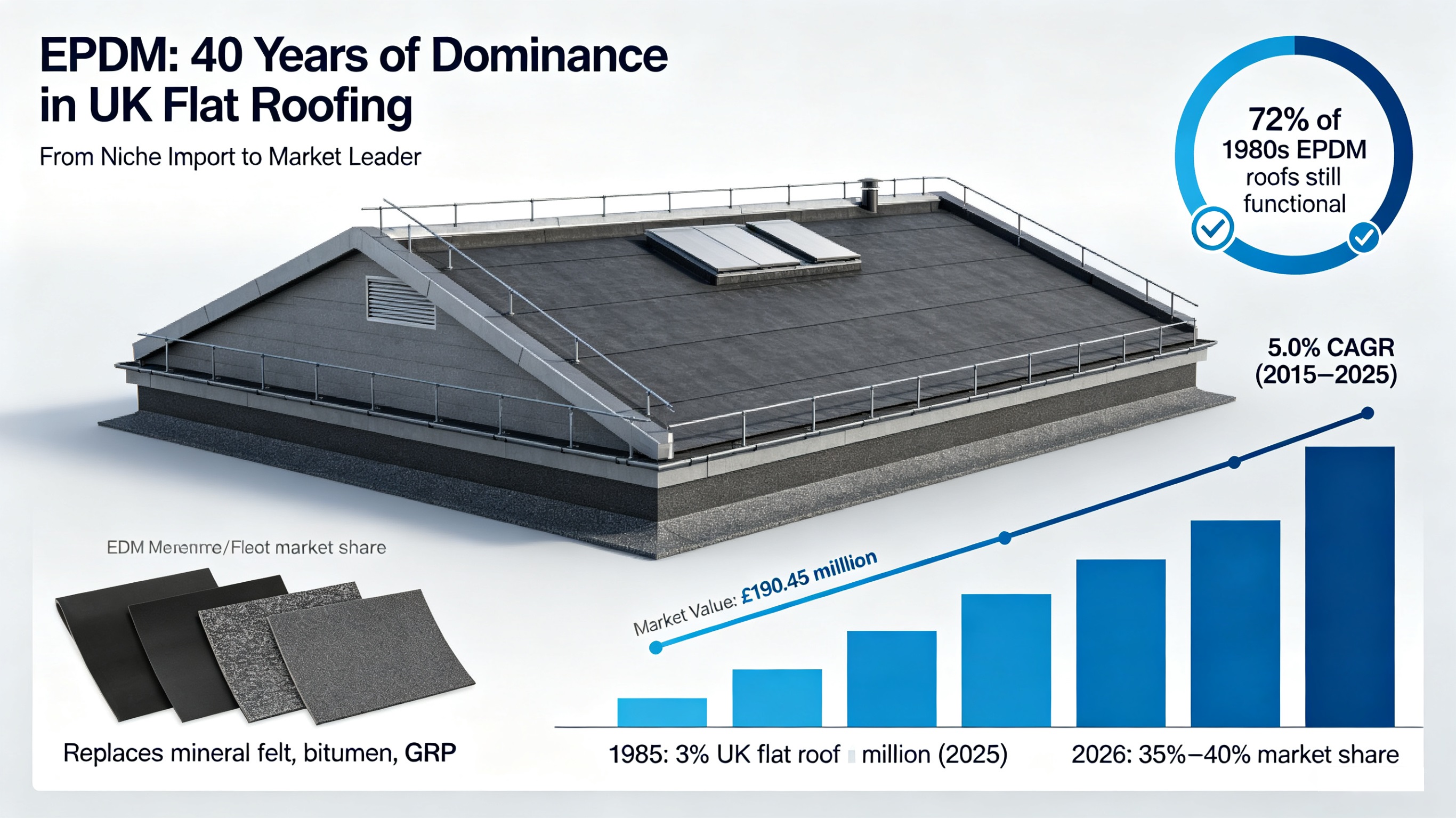
IndexBox UK construction data confirms the UK EPDM roofing membrane market value will hit £190.45 million in 2025, maintaining a steady annual compound growth rate of 5.0% over the past decade, driven by nationwide roof refurbishment programmes and UK green building regulations update.
After four decades of real-world exposure under Britain’s changeable rainy, frosty and UV-intensive island climate, over 72% of the original 1980s UK EPDM roof installations remain fully functional without major overhaul, proving unmatched durability versus conventional roofing alternatives.
1. Four Decade Development Timeline of EPDM Single-Ply Roof in the UK
1980–1995: Initial Import & Pilot Application Period (Market Exploration Stage)EPDM single-ply rubber membrane first entered the UK via North American raw material manufacturers starting 1982, limited to large commercial warehouses, supermarket distribution centres and municipal public facility pilot roof projects across England and Scotland.
Back in 1985, UK annual EPDM roof installation area stood at merely 210,000 m², occupying just 2.8% of national flat roof market; most domestic housebuilders and local roof contractors still stuck with low-cost mineral felt roofing with average 12–15 years service lifespan.
During this phase, British industry completed the first round of local climate adaptability testing, drafting initial reference specifications aligned with BS EN 13956 flexible waterproof sheet standard, laying foundation for later nationwide popularisation.
1996–2010: Rapid Market Penetration & Standard System Formulation
UK local building authorities updated Approved Document C (moisture resistance regulation) and BS 6229 flat roof construction code, officially recognising certified single-ply EPDM as compliant waterproof material for new-build and retrofit projects from 1998.
NFRC (National Federation of Roofing Contractors UK) released dedicated CoP 2 single-ply installation guidance for EPDM, standardising fully-bonded, mechanically-fixed and ballasted three mainstream construction methods still widely used in 2026.
By 2010, EPDM captured 27% of UK flat roof share, annual installed surface jumped to 3.2 million m²; residential extension flat roof, garage roof and small outbuilding projects became core growth segment, with DIY EPDM roof kits emerging in nationwide builders’ merchants.
2011–2026: Maturity & Sustainable Green Construction Driven Expansion (Latest 15 Years)
Post-Brexit UKCA certification replaced partial CE marking for construction-grade EPDM membrane from early 2021, tightening raw material qualification threshold and eliminating unqualified low-standard imported rubber sheets from domestic market.
UK national net-zero building policies pushed green roof, PV-integrated roof and recycled-content EPDM development; recycled EPDM membrane now accounts for 31% of total UK EPDM roofing consumption in 2026, up from only 8% in 2012.
Current market statistic: EPDM accounts for 35%~40% of all UK single-ply flat roof installations, split as 52% residential retrofit & new extension, 38% commercial/industrial warehouse roof, 10% council public school & community building roofing projects.
2. Key Advantages That Fueled 40-Year Continuous EPDM Growth in UK Construction
2.1 Excellent UK Climate AdaptabilityEPDM rubber features up to 300% reversible elasticity, perfectly coping with Britain’s rapid day-night temperature fluctuation, seasonal freeze-thaw cycle and frequent heavy rain; no crack or split caused by thermal expansion & contraction, the top failure reason for traditional bitumen roof in UK high-humidity coastal regions. Its strong ozone & UV resistance avoids ageing hardening under long-term UK cloudy-spell intermittent sunshine, the core reason enabling multi-decade service life.
2.2 Cost-Performance Superiority Over Full Lifecycle
While initial EPDM installation cost (£110–£200/m² in 2026 UK) is higher than cheap mineral felt (£70–110/m² upfront), its ultra-long service cycle slashes recurring replacement and repair cost; independent UK construction cost research confirms EPDM delivers the lowest whole-life cost per year among all mainstream flat roof materials across British market after 40 years of cost tracking.
2.3 Eco-Friendly Matching UK Net-Zero Construction Trend
Pure EPDM membrane is fully recyclable, no toxic volatile substance during production and installation; UK green building BREEAM certification awards extra scoring for projects adopting recycled-content EPDM roofing, driving fast-growing demand in government-funded public construction over recent decade.
3. Future Development Trend of UK EPDM Single-Ply Roof Membrane
Driven by UK 2050 net-zero carbon target, the domestic EPDM roofing market will keep 4.2% average annual growth till 2032 per industry forecast.
Three clear development directions: higher recycled rubber proportion membrane, PV-bonded integrated EPDM roof system and lightweight fleece-backed single-ply variants for rapid new-build installation.
With over 3.8 million ageing UK flat roofs built before 1990 entering large-scale retrofit window from 2027 onwards, EPDM will maintain its dominant single-ply roofing position in UK construction for another 30+ years after its 40-year development milestone.
Conclusion
Over four decades since entering the UK construction industry in early 1980s, single-ply EPDM rubber roof membrane has evolved from unknown imported new material into Britain’s most trusted flat roof waterproofing solution supported by complete national standards, mature installation technology and massive real-world 40-year performance data.
Backed by stable market growth, superior climate adaptability and sustainable development attributes, EPDM remains the top preferred specification for UK roof contractors, distributors and property developers for both new construction and existing roof renovation across residential, commercial and public building sectors.
