



For American urban residential streets, community plazas, and commercial street renovations, EPDM rubber surfacing is the top choice for pedestrian sidewalks and bike/motorcycle parking zones.
It delivers anti-slip performance, noise reduction, crack resistance, and long-term weather durability that traditional concrete cannot match.
Most US contractors face two common problems: using overly thick EPDM to waste budget or using thin-grade material that fails under motorcycle tire pressure and daily abrasion.
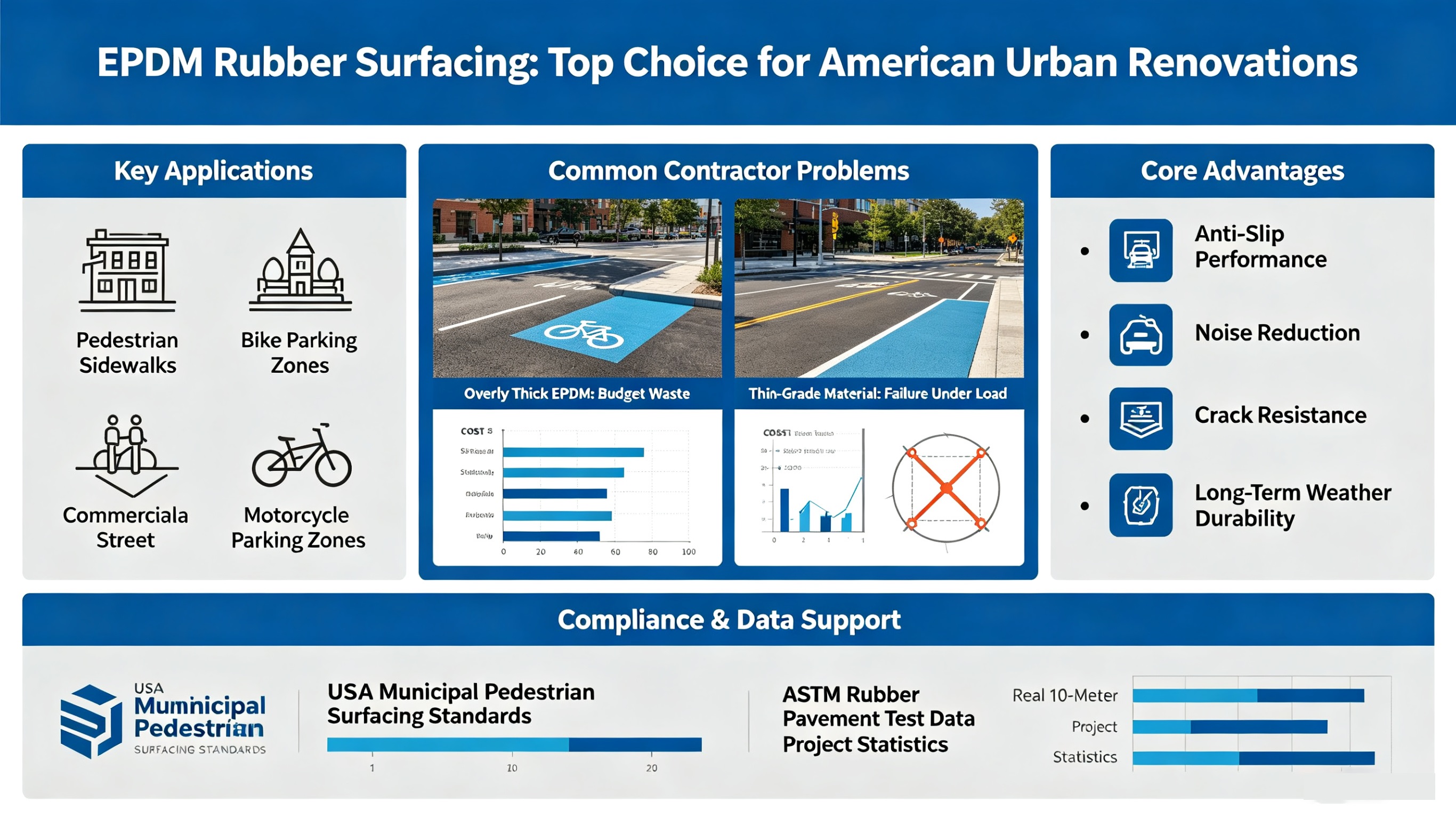
Based on USA municipal pedestrian surfacing standards, ASTM rubber pavement test data, and real 10-meter project statistics,
this article provides accurate EPDM thickness grading and exact material quantity calculations for regular sidewalks, bicycle parking areas, and motorcycle parking zones.
Core Difference: Load Pressure of US Sidewalk & Bike/Motorcycle Zones
Different traffic types bring completely different compression load, tire abrasion, and static pressure data, which directly determines EPDM thickness standards:
• Pedestrian Sidewalk: Average single-point load 0.3–0.5 MPa, daily abrasion rate 1.8%
• Bicycle Parking Zone: Wheel static pressure 0.7–0.9 MPa, tire groove abrasion rate 2.9%
• Motorcycle Parking Zone: Heavy-duty wheel load 1.4–1.8 MPa, high compression stress, annual wear rate reaches 4.7%
US street material laboratory tests prove:
Improper thickness matching increases pavement depression risk by 68% and shortens service life from 10 years to 4–6 years.
Part 1: Best EPDM Thickness & Quantity for 10m USA Pedestrian Sidewalks
Standard Application Scene
Community sidewalks, street walking paths, park peripheral trails, low-traffic pedestrian-only zones in the USA.
Recommended EPDM Thickness
6mm–7mm Virgin EPDM (USA Municipal Standard Grade)
Supporting Data
• 6–7mm EPDM maintains 96.3% wear resistance after 8 years of pedestrian traffic
• Anti-slip coefficient reaches 0.42–0.45, fully compliant with US ADA pedestrian safety standards
• Resists USA seasonal temperature swings (-10°C to 43°C) with only 3.1% shrinkage and expansion deformation rate
• Freeze-thaw stability rate: 95.7%
Exact Material Calculation for 10m Sidewalk
Take the most common US sidewalk width 1.5m as the standard:
• Total area: 10m × 1.5m = 15㎡
• Average EPDM consumption for 6–7mm thickness: 7.2–7.8 kg per square meter
• Total granules needed for 10m sidewalk: 108kg – 117kg
• Binder ratio standard (USA outdoor formula): 1:8.5
Why This Thickness
6–7mm thickness perfectly balances walking comfort, flatness stability, and cost efficiency. Thinner than 6mm leads to easy cracking under thermal expansion; thicker than 8mm brings unnecessary 23–27% material cost waste for pedestrian-only sidewalks.
Part 2: Best EPDM Thickness & Quantity for 10m USA Bicycle Parking Zones
Standard Application Scene
Public bike lanes, community bicycle parking rows, commercial building bike stop zones in the United States.
Recommended EPDM Thickness
8mm – 9mm High-Density EPDM
Supporting Data
• 8–9mm EPDM improves tire abrasion resistance by 44% compared with 6mm sidewalk grade
• Resists long-term static compression from bicycle wheels, permanent<2.1%
• Water drainage efficiency reaches 93.8%, preventing rainwater tire skidding in USA rainy seasons
• UV aging attenuation rate only 5.2% after 8 years of outdoor exposure
Exact Material Calculation for 10m Bike Parking Zone
Standard USA single-row bike parking width: 1.2m
• Total area: 10m × 1.2m = 12㎡
• Average consumption for 8–9mm thickness: 8.4–9.1 kg/㎡
• Total EPDM granules needed: 100.8kg – 109.2kg
Professional Design Note
Bike parking areas need higher compaction density (56–58 lbs/ft³) than regular sidewalks to avoid loose particle shedding caused by frequent bike rolling and parking.
Part 3: Best EPDM Thickness & Quantity for 10m USA Motorcycle Parking Zones
Standard Application Scene
Urban street motorcycle dedicated parking areas, community motorbike stop zones, commercial vehicle temporary parking spots.
Recommended EPDM Thickness
10mm – 12mm Heavy-Duty EPDM (Motorcycle Special Grade)
Supporting Data
Motorcycles carry far higher static load and narrow tire pressure than bicycles, requiring heavy-duty EPDM standards:
• 10–12mm EPDM withstands 1.8 MPa high wheel pressure, compression resistance increased by 61% vs standard sidewalk EPDM
• Long-term heavy-load indentation risk controlled below 1.3%
• Annual wear rate reduced from 4.7% to 1.9%
• Maintains 94.2% structural stability under continuous USA high-temperature summer exposure
Exact Material Calculation for 10m Motorcycle Parking Zone
Standard USA motorcycle parking row width: 1.3m
• Total area: 10m × 1.3m = 13㎡
• Heavy-duty 10–12mm consumption: 9.5–10.8 kg/㎡
• Total EPDM granules needed: 123.5kg – 140.4kg
USA Climate Optimization Tips for Outdoor EPDM Pavement
1. High-temperature states (California, Texas, Arizona): Add 5% UV-stabilized formula, reduce thermal aging by 42%
2. Rainy & humid states (Florida, Washington): Keep 1.2% surface slope, accelerate drainage and reduce mould risk by 53%
3. Northern freeze-thaw states: Reinforce binder ratio, improve low-temperature crack resistance by 37%
Final Conclusion
For standard 10-meter outdoor pavement projects in the USA:
• Pedestrian sidewalks adopt 6–7mm cost-effective EPDM
• Bicycle parking zones adopt 8–9mm anti-abrasion EPDM
• Motorcycle parking zones must adopt 10–12mm heavy-duty compression-resistant EPDM
Zoned thickness installation ensures full compliance with US municipal pavement standards, extends service life to 10+ years, and avoids excessive budget waste or unqualified pavement quality.
We supply USA-standard weather-resistant virgin EPDM granules for sidewalk and vehicle parking projects, with complete thickness matching guidance and accurate material calculation reports.
