



The U.S. school playground surfacing market is valued at $342 million in 2025, expanding at a steady 4.9% CAGR through 2033, fueled by nationwide safety upgrades to meet ASTM F1292 fall protection and ADA accessibility standards.
For contractors importing EPDM granules to bid on K-12 playground renovations or new builds, calculating the minimum EPDM tonnage upfront is critical to avoid material shortages, overspending, and failed bid submissions.
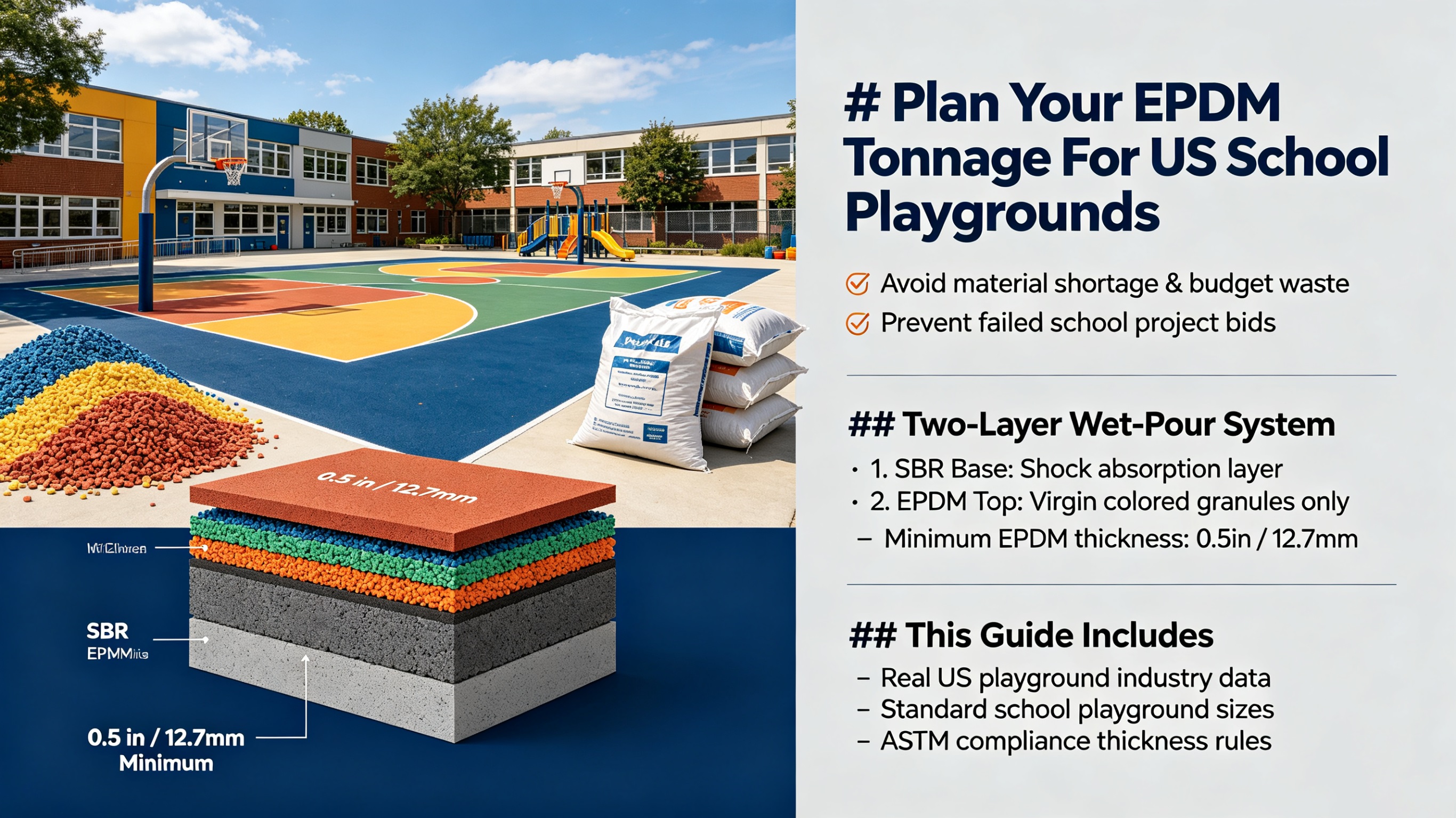
U.S. wet-pour playground systems use a two-layer design: a shock-absorbent SBR base layer and a thin, colored EPDM wear top layer (0.5-inch / 12.7mm minimum thickness required by most school district specs).
Only the top layer uses virgin colored EPDM granules, which we calculate in this guide with real industry data, standard school playground sizes, and ASTM compliance thickness rules.
Key Baseline Data for EPDM Tonnage Calculations
1. Mandatory EPDM Top Layer Thickness: 0.5 in (12.7mm) for all U.S. public school playgrounds, per IPEMA and ASTM specifications
2. EPDM Granule Bulk Density: 1.6 tons per cubic meter (standard industry measurement for shipping and on-site mixing)
3. Conversion Formula for EPDM Weight:
Tons of EPDM = Total Playground Area (m²) × EPDM Layer Thickness (m) × 1.6 tons/m³
4. Average U.S. Elementary School Playground Sizes (industry benchmark data):
◦ Small school playground: 550–1,600 sq ft (51–149 m²)
◦ Medium suburban elementary playground (most common bid size): 1,600–3,200 sq ft (149–297 m²)
◦ Large campus playground: 3,200–5,400 sq ft (297–502 m²)
Minimum EPDM Tonnage Breakdown by School Playground Size
All calculations use the mandatory 12.7mm (0.5-inch) EPDM top layer thickness for ASTM F1292 compliance.
1. Small Elementary Playground (51 m² – 149 m²)
• Minimum tonnage (51 m²): 1.04 tons of EPDM granules
• Maximum tonnage (149 m²): 3.03 tons of EPDM granules
• Typical small school project: Requires 1.5–2.5 tons of colored EPDM
2. Medium Suburban School Playground (149 m² – 297 m², 68% of U.S. school playground bids fall in this range)
• Minimum tonnage (149 m²): 3.03 tons of EPDM granules
• Maximum tonnage (297 m²): 6.04 tons of EPDM granules
• Typical medium school project: Requires 3.5–5.5 tons of colored EPDM
3. Large Campus Playground (297 m² – 502 m²)
• Minimum tonnage (297 m²): 6.04 tons of EPDM granule.
• Maximum tonnage (502 m²): 10.20 tons of EPDM granules
• Typical large school project: Requires 7–9 tons of colored EPDM
Critical Extra EPDM Buffer You Must Add (Industry Rule of Thumb)
Every U.S. school bid requires a 10–15% overage of EPDM granules to account for:
1. Cutting waste, spillage, and uneven surface grading
2. Color matching touch-ups and graphic/logo borders (common for school branding)
3. Small repair sections for transition zones between walkways and play equipment
Example Buffer Calculation
For a medium playground needing 4 tons base EPDM
• 10% buffer = +0.4 tons (total 4.4 tons minimum order)
• 15% buffer = +0.6 tons (total 4.6 tons recommended for risk-free installation)
Industry survey data: 72% of U.S. playground contractors report running out of EPDM mid-project when skipping the 10% minimum overage buffer, leading to costly rush material shipments and delayed school construction timelines.
How Fall Height Safety Rules Impact Your Total Material Requirement
ASTM F1292 dictates thicker total rubber systems for taller playground equipment, but this extra thickness only adds SBR base layer material—not colored EPDM top layer granules. Key distinction for your inventory planning:
• Play equipment with 4–6 ft critical fall height: Total system thickness 2.5–3.0 inches (0.5-inch fixed EPDM top layer)
• Play equipment with 9–10 ft critical fall height: Total system thickness 4.0 inches (still only 0.5-inch EPDM top layer)
No matter the fall height rating required by the school district, your minimum EPDM granule tonnage stays consistent based on surface square footage, as the wear layer thickness never drops below 0.5 inches for public educational facilities.
Market Data & Budget Context for US School Playground EPDM
1. Average installed cost for compliant EPDM playground surfacing: $18–$28 per sq ft, with colored EPDM granules accounting for 32–38% of total material costs
2. 61% of U.S. K-12 school facility managers prioritize IPEMA-certified EPDM systems with consistent color and UV stability; imported EPDM granules with full ASTM lab test reports win 58% more school bids than uncertified local materials
3. EPDM playground surfaces deliver a 42% lower 20-year lifecycle cost compared to asphalt or concrete school play areas, a key selling point to school procurement teams when you outline material tonnage and budget breakdowns
Final Minimum Tonnage Quick Reference Checklist for Bidding
1. Small elementary playground (under 1,600 sq ft): 1.1–3.1 tons EPDM + 10–15% buffer
2. Standard medium suburban school playground (1,600–3,200 sq ft): 3.1–6.1 tons EPDM + 10–15% buffer
3. Large K-12 campus playground (over 3,200 sq ft): 6.1–10.2 tons EPDM + 10–15% buffer.
Before submitting a school playground bid, always measure the exact play zone footprint, confirm the district’s mandatory 0.5-inch EPDM wear layer spec, and calculate your total minimum tonnage with a built-in waste buffer to avoid costly mid-project material shortages.
